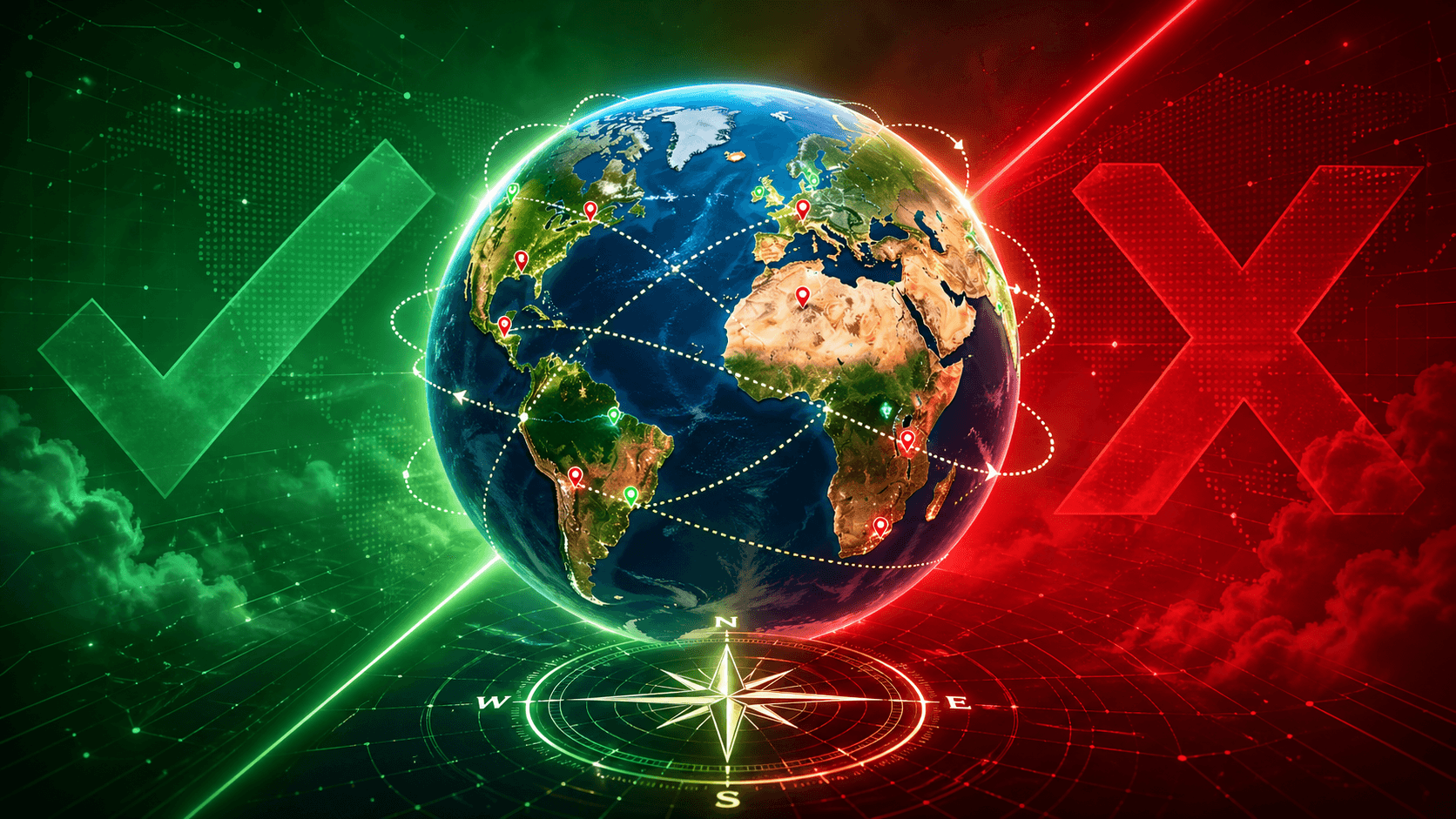
Geography Quiz: Can You Place These 15 Countries on a Map?
Let us be honest: world geography is a challenge for most of us. Even the most well-read people regularly confuse certain countries, place them on the wrong continent, or mix up capitals. In a hyperconnected world where information flows in real time, it is paradoxical how approximate our knowledge of physical geography remains. A 2023 study revealed that only 36% of Europeans could correctly place more than 10 countries on a blank map. Here are 15 countries that most people struggle to locate correctly, along with fascinating facts that will make you want to learn more about them.
Asia
1. Kazakhstan
Many people picture Kazakhstan as a small Central Asian nation. In reality, it is the 9th largest country in the world — bigger than all of Western Europe combined. It stretches from the Caspian Sea to the Chinese border, and part of its territory is actually in Europe.
Kazakhstan also has the longest continuous land border with a single country: 7,644 km with Russia. Its capital, Astana (renamed Nur-Sultan between 2019 and 2022), is one of the coldest capitals in the world, with winter temperatures reaching -40°C.
Did you know? The Baikonur Cosmodrome, from which the first human was launched into space (Yuri Gagarin in 1961), is located in Kazakhstan. Russia leases it for $115 million per year.
2. Sri Lanka
This teardrop-shaped island lies southeast of India in the Indian Ocean. Many confuse it with Madagascar or place it near Indonesia. Sri Lanka is actually a fascinating cultural bridge between South and Southeast Asia, with extraordinary biodiversity for its size.
Despite its modest area (65,610 km2, slightly larger than Switzerland), Sri Lanka is home to 8 UNESCO World Heritage sites and produces some of the world's finest teas. It is also a major center of Theravada Buddhism, with spectacular temples dating back over 2,000 years.
3. Mongolia
Sandwiched between Russia and China, Mongolia is often forgotten on mental maps. This vast country — three times the size of France — is one of the least densely populated in the world, with its endless steppes and the Gobi Desert. With only 2 inhabitants per square kilometer, Mongolia contrasts radically with its densely populated neighbors.
Did you know? Mongolia has more horses per capita than any other country. With approximately 4 million horses for 3.3 million people, there are more horses than humans.
Africa
4. Madagascar
The world's fourth largest island, Madagascar lies off the southeast coast of Africa in the Indian Ocean. Many place it too far north or confuse it with a Caribbean island. Its geographic isolation — separated from the African continent for roughly 88 million years — has made it a unique biodiversity paradise, with 90% endemic species found nowhere else on Earth.
Madagascar alone is home to over 100 species of lemurs, spectacular chameleons, and six of the world's eight baobab species. It is a living laboratory of evolution.
5. Ethiopia
Often associated with the arid Sahel, Ethiopia surprises with its geographic diversity: lush highlands rising above 4,500 meters, the Rift Valley, volcanic lakes, and scorching deserts. It is also the only African country never to have been colonized (except for a brief Italian occupation from 1936 to 1941) and the birthplace of coffee.
Ethiopia uses its own calendar, which has 13 months and runs 7 to 8 years behind the Gregorian calendar. It also has its own writing system, Ge'ez, which has been in use for over 2,000 years.
6. Lesotho
This small mountainous kingdom is entirely enclosed within South Africa — the only country in the world whose entire territory lies above 1,000 meters elevation. A geographic fact that even quiz enthusiasts often overlook. Lesotho's lowest point, at 1,400 meters, is higher than the highest point of many European countries.
Did you know? Only three countries are entirely enclosed within a single other country: Lesotho (within South Africa), San Marino (within Italy), and Vatican City (also within Italy).
South America
7. Colombia
Be careful not to confuse Colombia with British Columbia (in Canada)! Colombia is located in northwestern South America, with coastlines on both the Pacific and Caribbean. Many place it too far south, confusing it with Venezuela or Ecuador.
Colombia is the second most biodiverse country in the world (after Brazil) and first for bird species, with over 1,900 species recorded. It is also the world's leading producer of emeralds, supplying roughly 70% of global production.
8. Paraguay
Landlocked between Brazil, Argentina, and Bolivia, Paraguay is one of South America's most overlooked countries. Yet its Itaipu Dam, built jointly with Brazil, produces one of the world's largest amounts of hydroelectricity — enough to cover 90% of Paraguay's energy needs and 15% of Brazil's.
Paraguay is also one of the few South American countries where an indigenous language — Guarani — is co-official with Spanish and spoken by about 90% of the population, including non-indigenous people.
9. Suriname
A former Dutch territory, Suriname is the smallest country in South America. Located on the northeast coast between Guyana and French Guiana, it surprises with its official language — Dutch — and tropical forests covering 93% of its territory, making it one of the most forested countries on Earth.
Did you know? Suriname is the only country in South America where Dutch is the official language. Its population is among the most multi-ethnic in the world, with communities of Indian, Javanese, African, Chinese, and Amerindian origin.
Europe
10. Slovakia and Slovenia
These two countries are confused so often that their embassies regularly exchange misdirected mail! Slovakia (capital: Bratislava) borders Austria and Hungary, while Slovenia (capital: Ljubljana) borders Italy and Croatia.
A helpful mnemonic: Slovakia is to the north, Slovenia is to the south with access to the Adriatic Sea. Slovenia has only 47 km of coastline, making it one of the shortest maritime facades in Europe.
11. Moldova
Squeezed between Romania and Ukraine, Moldova is the least visited country in Europe. A former Soviet republic, it shares its language and much of its culture with Romania. Moldova holds an unusual record: it has the world's largest wine cellar, the Milestii Mici cellars, with over 200 km of underground galleries.
Oceania
12. New Zealand
A victim of the "forgotten on maps" phenomenon (there is even a dedicated subreddit: r/MapsWithoutNZ), New Zealand lies much further east and south than most people imagine — about 2,000 km from Australia. It is closer to Antarctica than to Asia.
New Zealand was the last major habitable landmass discovered by humans, roughly 700 years ago. It was also the first country in the world to grant women the right to vote, in 1893.
13. Tonga
This Polynesian kingdom of 171 islands is often confused with Fiji or Samoa. Tonga has the distinction of being one of the first places in the world to see the sunrise each day, thanks to its proximity to the International Date Line. It is also one of the last active Polynesian monarchies.
Middle East and Central Asia
14. Georgia
No, not the American state! Georgia is a country in the Caucasus, at the border between Europe and Asia, on the shores of the Black Sea. The cradle of winemaking with 8,000 years of viticultural history — making it the oldest wine region in the world — it surprises with its spectacular mountain scenery and rich cuisine.
Georgia has its own unique alphabet, Mkhedruli, with 33 letters that resembles no other writing system in the world. UNESCO has inscribed Georgian script on the Intangible Cultural Heritage list.
15. Bhutan
Nestled in the Himalayas between India and China, Bhutan is famous for measuring "Gross National Happiness" rather than GDP. This small kingdom is the only country in the world with a negative carbon footprint, absorbing more CO2 than it emits, thanks to forest coverage exceeding 70% of its territory.
Did you know? Bhutan did not allow television until 1999, becoming one of the last countries to adopt it. The sale of tobacco has been banned there since 2004.
Tips for Better Remembering Geography
- Use interactive maps: online tools like Google Earth allow you to explore the world intuitively.
- Associate memorable facts: linking a country to an anecdote helps you remember it (e.g., "Lesotho is the highest country in Africa").
- Play quizzes regularly: spaced repetition is the most effective method for anchoring knowledge in long-term memory.
- Follow international news: world events are an excellent opportunity to locate countries on a map.
Conclusion
Geography is much more than a list of countries and capitals to memorize. Every nation holds fascinating particularities that tell the story of its history, culture, and place in the world. From Mongolia's endless steppes to Bhutan nestled in the Himalayas, each country has a unique story to tell. So, how many of these 15 countries could you have correctly placed on a map? Challenge yourself with our geography quizzes and discover whether your knowledge of the world is up to scratch.
Test your geography knowledge