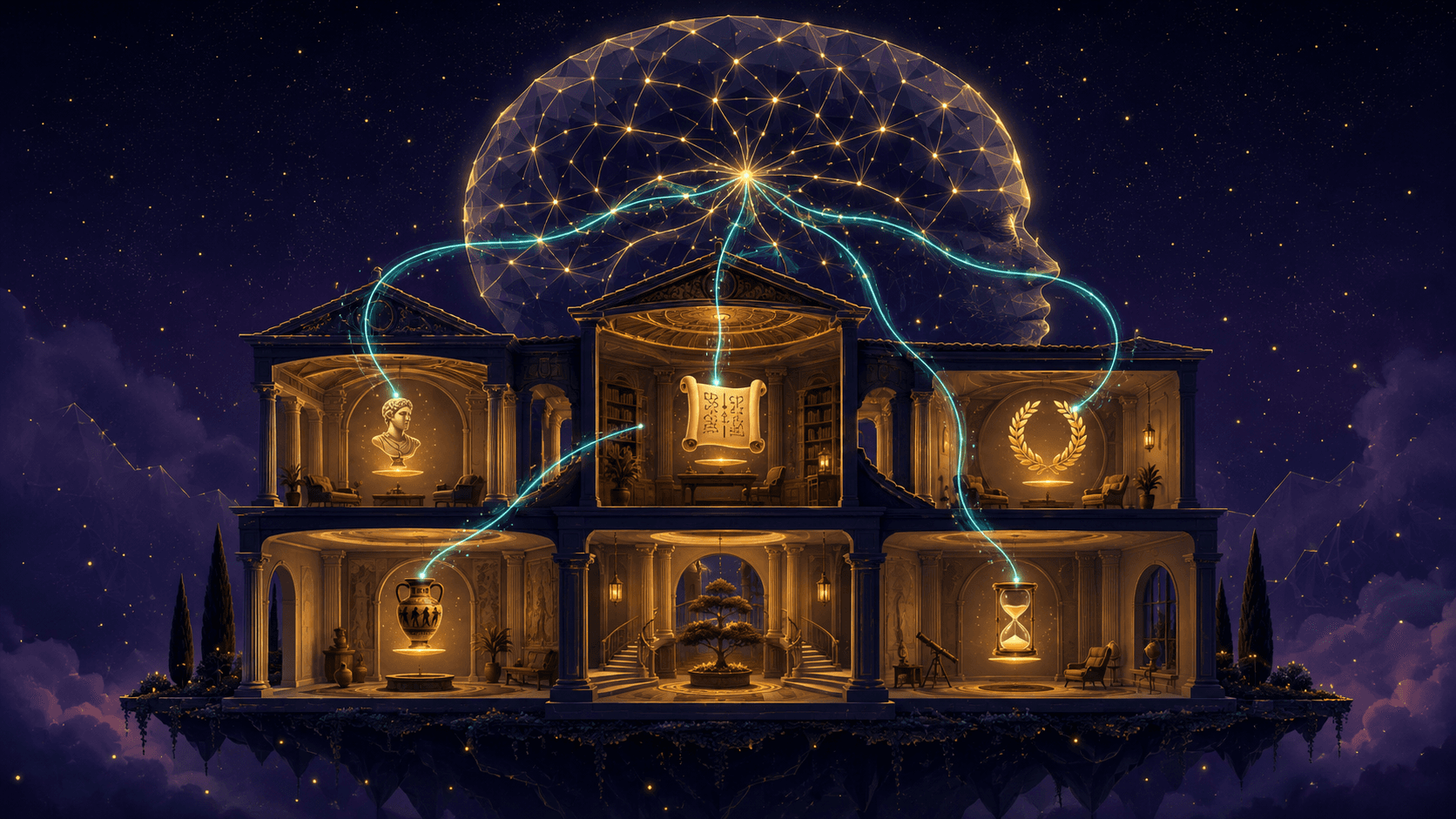
The Memory Palace: The Ancient Technique to Memorize General Knowledge
Imagine having to recite, with no notes whatsoever, a four-hour speech in front of the Roman Senate. No teleprompter, no PowerPoint. Just your voice and your memory. Cicero did it. And he wasn't a freak of nature: he simply used a technique more than 2,000 years old. Today this technique is called the memory palace, or method of loci. And modern science has proved it's one of the most powerful weapons for memorizing general knowledge.
The origin: a Greek poet and a collapsing roof
According to the legend reported by Cicero himself, the Greek poet Simonides of Ceos was attending a banquet when the roof collapsed. Every guest was crushed beyond recognition. Simonides, who had stepped outside a few minutes earlier, was the only one able to identify each body: he remembered exactly where each guest had been seated. This anecdote is said to have inspired the method of loci ("places" in Latin): pairing a piece of information with a physical location to recall it later at will.
For 2,000 years, this technique was taught in every school of rhetoric. Then the printing press arrived, and we forgot it. Except among modern memory champions, who still use it every day.
How it works: your brain loves places
Our spatial memory is one of the most powerful in our cognitive arsenal. Can you describe your kitchen with your eyes closed? Of course. Can you remember the route to your parents' house even 20 years later? Obviously. This memory is anchored in a precise area of the brain: the hippocampus, which contains the famous place cells discovered by John O'Keefe (Nobel Prize in Medicine 2014).
The memory palace hijacks this system. You take a place you know by heart (your home, your morning commute, your old school) and mentally "deposit" the information you need to remember there. When recalling, you mentally walk the route, and each piece of information reappears at its location.
That's exactly what science has confirmed. To dive deeper, read our pillar article Why quizzes improve memory, which details the general neurological mechanisms of the testing effect.
How to use it: 5 steps to build your first palace
Here's the method step by step. Let's take a concrete example: memorizing the capitals of 5 European countries.
Step 1: choose a familiar place
Your home or apartment is ideal to start with. You know every room, every piece of furniture. The more familiar, the more solid the anchor.
Step 2: define a fixed route
Start from the entrance, cross the living room, head to the kitchen, the bedroom, the bathroom, and so on. The order must always be the same. This is what we call the "memory route".
Step 3: create a striking mental image
This is where the magic happens. For Berlin (Germany), don't just imagine "the word Berlin lying on the couch". Instead, imagine a giant bear eating a sausage-pretzel, sprawled out on your couch. Ridiculous? Perfect. The more absurd, multisensory and emotional, the longer it sticks.
Step 4: place each fact in a specific spot
- Entrance: Madrid → a matador bull dancing flamenco on your doormat
- Living room: Berlin → the sausage bear crushing your couch
- Kitchen: Rome → a gladiator cleaning your fridge with a sword
- Bedroom: Athens → Socrates sleeping in your bed, wearing a toga
- Bathroom: Lisbon → a yellow tram coming out of your shower
Step 5: walk the route mentally, several times
In the morning, on the subway, before falling asleep: replay your route. After 3-4 repetitions, the associations are etched in. You can then test them by playing a quiz like European Capitals Easy.
Scientific validation: MRIs of memory champions
In 2003, Eleanor Maguire's team (University College London) compared the brains of 10 memory champions to those of 10 ordinary people. Verdict: no significant anatomical difference. But during memorization tasks, champions massively activated three specific areas: the right hippocampus, the medial parietal cortex, and the retrosplenial cortex: exactly the regions involved in spatial navigation. The researchers concluded: "their performance does not rely on exceptional brains, but on the systematic use of the method of loci".
A 2017 study (Dresler et al., published in Neuron) went further: it trained a group of novices for six weeks; those who practiced the method of loci doubled their recall capacity (from ~26 to ~62 words out of 72), and their brains began to show connectivity patterns similar to those of champions. The technique is learnable.
Who does it work best for?
Generally speaking, everyone. But a few profiles get an immediate boost:
- Visual thinkers: if you easily remember scenes from movies, this is your natural playground.
- Travelers: you already have dozens of mental locations available (hotels, streets, museums).
- Students of history, geography, medicine, law: anything requiring memorization of ordered lists.
Non-visual thinkers (auditory or kinesthetic) can still use the technique, replacing images with sounds (voices, melodies) or sensations (warm, rough, heavy).
3 common mistakes to avoid
1. Images that are too tame. "A banana on the table" won't stick. "A giant banana singing Mozart on the table" will. Absurdity, emotion and movement are mandatory.
2. Too much info per location. Limit yourself to 1 or 2 items per spot. Otherwise it becomes mental mush.
3. Reusing the same palace for everything. One palace = one theme. If you put European capitals in your kitchen and the kings of France in the same kitchen, you'll get collisions. Build one palace per topic.
How to apply it to QuizFury quizzes
The memory palace pairs perfectly with quizzes, because quizzes test associations by pulling info in random order. Here are three concrete uses:
- Before a themed quiz (e.g. World Capitals): build your palace in 20 minutes, then play the quiz. You'll be impressed.
- To revise an entire category: walk around the neighborhood of your childhood and place a fact at each street number.
- For rapid flashcards: train with QuizFury's infinite mode, every missed card becomes a location to enrich in your palace.
You can also challenge a friend on general knowledge once your palace is solid. The satisfaction of beating someone using a 2,000-year-old technique is priceless.
Conclusion: memory is a skill, not a gift
The method of loci destroys the myth of innate "good memory". Cicero, Matteo Ricci (the Jesuit who memorized 500 Chinese ideograms in a single read), today's World Memory Championship winners: all use the same technique. With 30 minutes of practice per day for two weeks, anyone can double their retention capacity.
To go further, take a look at our 10 tips to improve your general knowledge and the 20 most asked general knowledge questions, a perfect training ground for your first palace.
Read also