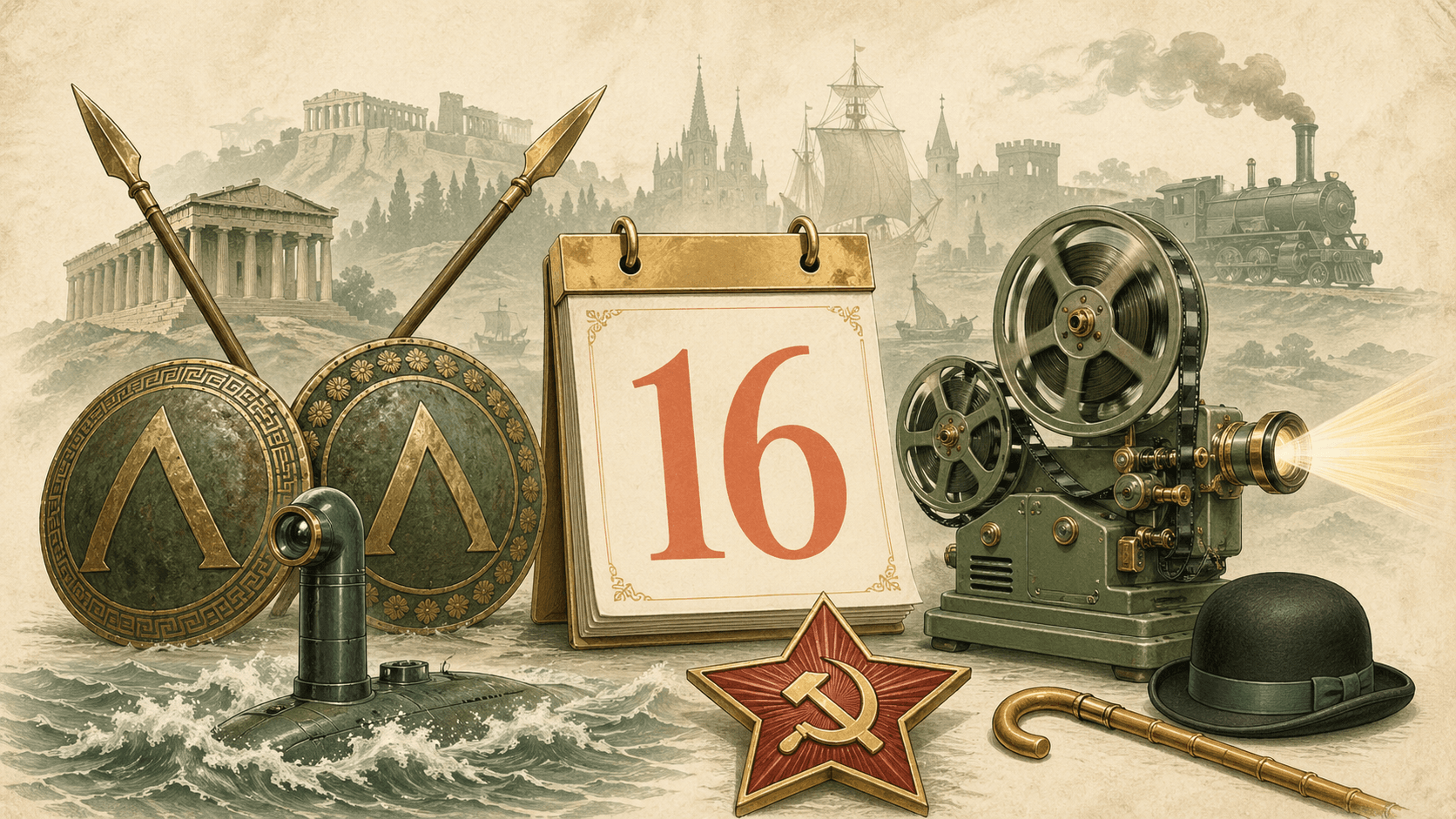
The 10 quiz questions
Question 1 : What is the historical particularity of the Battle of Megiddo in 1457 BC, commemorated on April 16?
Possible answers:
- It is the first battle to use war chariots on a large scale
- It is the first battle in History whose precise details are known to us
- It is the first battle pitting two distinct empires against each other
- It is the first battle won by a coalition against an empire
Explanation: The Battle of Megiddo is not only the first well-documented battle in History, but the site of Megiddo (in present-day Israel) is also associated in Christian tradition with Armageddon, the place of the final battle of the end of times. The records of Thutmose III, engraved on the walls of the Karnak temple, constitute an exceptional historical source.
Question 2 : How did Albert Hofmann discover the pharmacological properties of LSD on April 16, 1943?
Possible answers:
- By voluntarily testing the substance on himself in a clinical setting
- By observing the effects on laboratory animals
- After an accidental ingestion of the substance
- By analyzing reports on the use of Native American hallucinogenic plants
Explanation: Three days after this accidental discovery, on April 19, 1943, Hofmann conducted an intentional experiment by ingesting 250 micrograms of LSD and rode his bicycle home, experiencing the substance's intense hallucinogenic effects. This day has since been celebrated by some as "Bicycle Day".
Question 3 : What tragic event in the Baltic Sea on April 16, 1945 caused the death of approximately 6,500 people?
Possible answers:
- The torpedoing of the German liner Goya by a Soviet submarine
- The sinking of an Allied supply convoy in the North Sea
- The explosion of a Red Cross hospital ship
- The destruction of the German fleet by British bombers
Explanation: The sinking of the Goya is one of the worst maritime disasters in history, far deadlier than the Titanic. The German liner was carrying refugees fleeing the Soviet advance and was sunk by submarine S-13, commanded by Captain Alexander Marinesko, the same officer who had sunk the Wilhelm Gustloff in January 1945.
Question 4 : Which famous British actor, known for his Charlot character, was born on April 16, 1889?
Possible answers:
- Buster Keaton
- Harold Lloyd
- Charlie Chaplin
- Stan Laurel
Explanation: Charlie Chaplin, born in London, is considered one of the greatest geniuses of silent cinema. Ironically, when sound cinema developed, he long resisted using it, considering pantomime and physical expression to be superior to speech. His film "The Great Dictator" (1940) was his first true sound film.
Question 5 : The Treaty of Rapallo signed on April 16, 1922 established diplomatic relations between Germany and which other country?
Possible answers:
- Poland
- Turkey
- France
- The USSR
Explanation: The Treaty of Rapallo, signed during the Genoa Conference, was a major diplomatic surprise: two nations marginalized in the post-war international order, the Weimar Republic and the USSR, were drawing closer together. This treaty also included the mutual cancellation of their war debts and reparations.
Question 6 : Who invented the word "ordinateur" on April 16, 1955, and at the request of which company?
Possible answers:
- By a French engineer at the request of the CNRS
- By Professor Jacques Perret at the request of IBM
- By an academician at the request of the French government
- By a mathematician at the request of Bull
Explanation: Jacques Perret, professor of philology at the Sorbonne, proposed the term "ordinateur" as a replacement for the English word "computer". The term comes from the Latin "ordinator", designating one who puts in order. This specifically French term has no direct equivalent in other Romance languages, which all use derivatives of "computer".
Question 7 : On April 16, 2007, how many fatalities did the Virginia Tech shooting cause?
Possible answers:
- 22 dead including the shooter
- 28 dead including the shooter
- 33 dead including the shooter
- 47 dead including the shooter
Explanation: The Virginia Tech shooting, perpetrated by Seung-Hui Cho, a Korean-American student, remains the deadliest school shooting in American history. It deeply revived the debate on gun control and mental health in the country. The university has since erected a permanent memorial in tribute to the victims.
Question 8 : Which First World War battle began on April 16, 1917 in the Aisne?
Possible answers:
- The Battle of the Somme
- The Battle of the Chemin des Dames
- The Battle of Verdun
- The Battle of the Marne
Explanation: The Battle of Chemin des Dames, launched under the command of General Nivelle, was a military disaster despite promises of a rapid breakthrough. The considerable French losses (approximately 187,000 men in a few weeks) triggered the mutinies of 1917, a major crisis of the French army that General Pétain had to manage by replacing Nivelle.
Question 9 : In which field is Ernest Solvay, born on April 16, 1838, mainly famous?
Possible answers:
- He is famous for his discoveries in tropical medicine
- He is famous for his work in industrial chemistry, notably the Solvay process
- He is famous for his inventions in the field of electricity
- He is famous for his research in steel metallurgy
Explanation: Ernest Solvay revolutionized the chemical industry by inventing the Solvay process in 1861, allowing the industrial production of sodium carbonate (soda ash) on a large scale and at low cost. Becoming immensely wealthy, he funded the famous Solvay Conferences on physics, including the 1927 one which brought together Einstein, Bohr, Curie, and Heisenberg to debate quantum mechanics.
Question 10 : In what historical context did the Battle of Culloden, on April 16, 1746, take place?
Possible answers:
- During the Hundred Years' War between England and France
- During the Jacobite attempt to restore the Stuarts to the British throne
- During the American War of Independence
- During the wars of religion between Scottish Catholics and Protestants
Explanation: The Battle of Culloden was the last pitched battle fought on British soil. The defeat of the Jacobites ended the ambitions of Charles Edward Stuart ("Bonnie Prince Charlie") to restore the Stuarts to the British throne. In the following months, repression in the Highlands was terrible: the wearing of tartan and kilt was banned for nearly 40 years.

