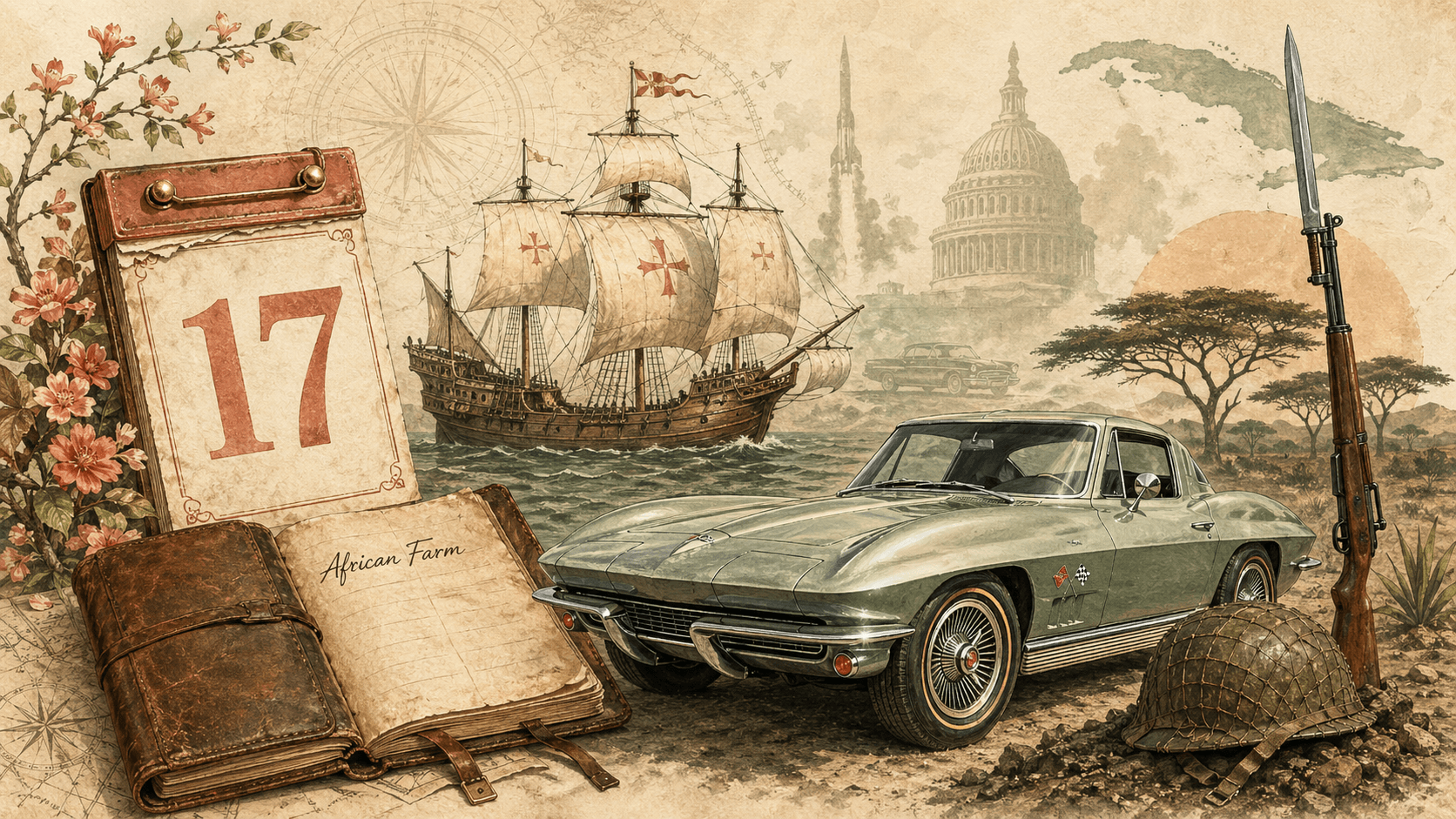
The 10 quiz questions
Question 1 : In 1492, the Capitulations of Santa Fe were signed on April 17. What was the main purpose of this agreement?
Possible answers:
- Allow Columbus to trade with the Indies by bypassing Africa
- Finance the construction of the Spanish fleet against the Ottomans
- Authorize Christopher Columbus to cross the Atlantic Ocean
- Establish a peace treaty between Spain and Portugal
Explanation: The Capitulations of Santa Fe granted Christopher Columbus the title of admiral, viceroy and governor general of the lands he would discover, as well as a share of the riches. Columbus would set sail from Palos de la Frontera on August 3, 1492 and reach the Americas on October 12.
Question 2 : Which Florentine navigator reached the bay of the future New York on April 17, 1524, in the service of King Francis I of France?
Possible answers:
- Amerigo Vespucci
- Giovanni da Verrazzano
- Jacques Cartier
- Giovanni Caboto
Explanation: Giovanni da Verrazzano was the first European to explore the east coast of North America from North Carolina to Newfoundland. In his honor, the Verrazzano-Narrows Bridge, inaugurated in 1964, spans the entrance to New York Harbor.
Question 3 : On April 17, 1825, King Charles X recognized the independence of Haiti in exchange for a financial indemnity. What was the initial amount demanded?
Possible answers:
- 50 million gold francs
- 90 million gold francs
- 150 million gold francs
- 200 million gold francs
Explanation: This indemnity, intended to compensate former French colonists, plunged Haiti into colossal debt that was repaid until 1947. It is often cited as one of the causes of the country's chronic underdevelopment. In 1838, the sum was reduced to 90 million gold francs.
Question 4 : What major Cold War event took place in Cuba on April 17, 1961?
Possible answers:
- The Cuban Missile Crisis
- The diplomatic break between Cuba and the United States
- The Bay of Pigs operation
- The nationalization of American companies by Castro
Explanation: The Bay of Pigs operation was an attempted invasion of Cuba by Cuban exiles trained and supported by the CIA. It ended in a stinging failure within three days and paradoxically reinforced Fidel Castro's position, while embarrassing the Kennedy administration.
Question 5 : In 1975, the Khmer Rouge captured Phnom Penh. Who was the leader of the Khmer Rouge at that time?
Possible answers:
- Hun Sen
- Norodom Sihanouk
- Lon Nol
- Pol Pot
Explanation: Pol Pot, secretary general of the Communist Party of Kampuchea, led the Khmer Rouge regime from 1975 to 1979. His regime caused the death of approximately 1.7 million people, nearly a quarter of the Cambodian population, in what is known as the Cambodian genocide.
Question 6 : On April 17, 1970, the Apollo 13 mission returned to Earth. Why is this mission still famous in the history of space exploration?
Possible answers:
- It was the first manned mission to orbit the Moon
- One astronaut was left alone in orbit while two others walked on the Moon
- The mission had to be aborted following an explosion onboard and the crew returned safely
- It was NASA's last manned mission for ten years
Explanation: Apollo 13 lifted off on April 11, 1970. On April 13, an oxygen tank exploded, forcing the crew to use the lunar module as a lifeboat. The phrase "Houston, we have a problem" became legendary. Despite the failure of the lunar mission, the safe return of the crew was considered a success.
Question 7 : On April 17, 1964, Ford unveiled the Mustang at the New York World's Fair. What commercial peculiarity distinguished this launch?
Possible answers:
- It was the first car sold directly online without going through a dealer
- The Mustang was unveiled simultaneously in all American dealerships on the same day
- Ford gave away 500 Mustangs for free at the World's Fair
- It was the first American car equipped with a stock turbo engine
Explanation: The Ford Mustang, initially sold for $2,368, was a phenomenal commercial success: 22,000 units were sold on the first day and more than a million in less than two years. It gave rise to the "pony car" category, affordable sports cars, later imitated by the Chevrolet Camaro and the Dodge Challenger.
Question 8 : Born on April 17, 1885, Karen Blixen is best known for writing a famous novel inspired by her life in Africa. What is this novel?
Possible answers:
- The Tartar Steppe
- Out of Africa
- Letters from Africa
- Night Herbs
Explanation: Karen Blixen, who wrote under the pseudonym Isak Dinesen, recounts in "Out of Africa" (1937) her seventeen years spent in Kenya managing a coffee plantation. The novel was adapted to film in 1985 by Sydney Pollack, with Meryl Streep and Robert Redford, winning seven Oscars.
Question 9 : The Treaty of Shimonoseki, signed on April 17, 1895, ended which armed conflict?
Possible answers:
- The Russo-Japanese War
- The First Sino-Japanese War of 1894-1895
- The Boxer Rebellion in China
- The 19th-century Korean War
Explanation: The Treaty of Shimonoseki sealed Japan's resounding victory over China in the First Sino-Japanese War. China ceded Taiwan, the Pescadores Islands and the Liaodong Peninsula to Japan. This treaty marked the emergence of Japan as an imperialist power and foreshadowed the tensions that would lead to the Russo-Japanese War of 1904-1905.
Question 10 : On April 17, 1521, Martin Luther appeared before the Diet of Worms. What was the direct consequence of this summons?
Possible answers:
- He was sentenced to be burned at the stake by the Inquisition
- He agreed to recant and was reinstated in the Catholic Church
- He was placed under the ban of the Empire after refusing to recant
- He was named Protestant bishop by the German princes
Explanation: Before the Diet of Worms, Luther refused to recant and reportedly uttered the famous phrase: "Here I stand, I can do no other." The Edict of Worms, signed on May 25, 1521 by Charles V, declared him a heretic and outlaw. He found refuge at Wartburg Castle, where he translated the New Testament into German, laying the foundations of the modern German language.

