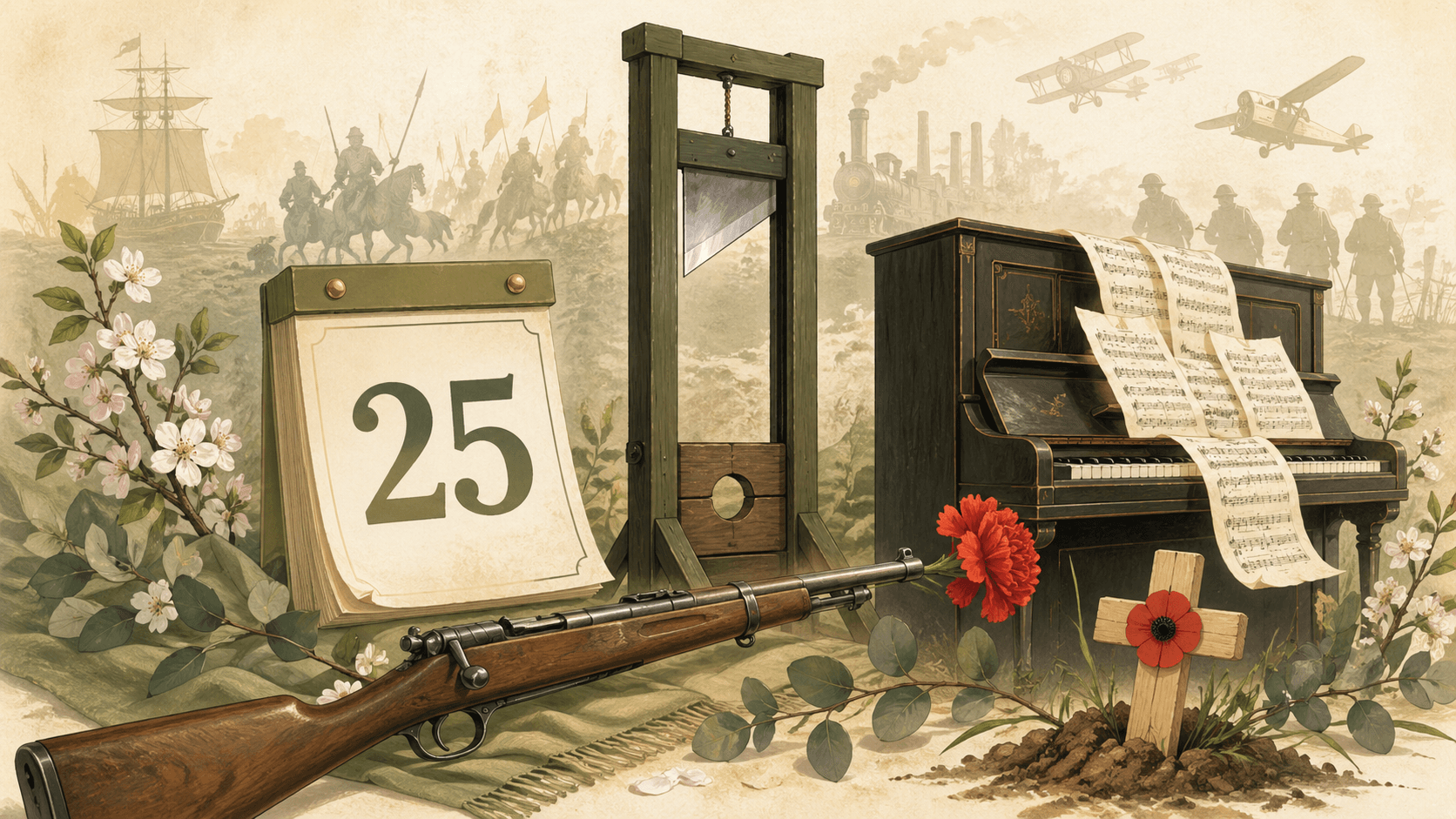
The 10 quiz questions
Question 1 : Which revolution ended the Portuguese dictatorship on April 25, 1974?
Possible answers:
- The Tulip Revolution
- The Rose Revolution
- The Carnation Revolution
- The Jasmine Revolution
Explanation: The Carnation Revolution (revolução dos cravos) owes its name to the flowers that civilians slipped into the barrels of soldiers' rifles. It put an end to 48 years of authoritarian regime, the Estado Novo, and paved the way for the decolonization of Portuguese territories in Africa such as Angola and Mozambique.
Question 2 : Who was the first condemned person to be executed by guillotine, on April 25, 1792, at Place de Grève in Paris?
Possible answers:
- Georges Danton
- Nicolas Jacques Pelletier
- Jean-Paul Marat
- Louis-Auguste de Bourbon
Explanation: Nicolas Jacques Pelletier, condemned for armed robbery, was the first guillotined. The guillotine, promoted by Dr. Joseph-Ignace Guillotin, was adopted by the French Revolution as an egalitarian method of execution. It only bore the name of its promoter through popular derision, Guillotin having merely recommended its use.
Question 3 : In which scientific journal was the discovery of the structure of DNA by Crick and Watson published on April 25, 1953?
Possible answers:
- Science
- The Lancet
- Cell
- Nature
Explanation: The journal Nature simultaneously published three complementary articles on the double helix structure of DNA. Besides Crick and Watson, Rosalind Franklin and Maurice Wilkins had decisively contributed to this discovery. Franklin, whose work in X-ray crystallography was essential, never received the Nobel, having died in 1958 before the prize was awarded in 1962.
Question 4 : Which famous battle of April 25, 1918 saw the victory of ANZAC troops?
Possible answers:
- Battle of the Somme
- Battle of Villers-Bretonneux
- Battle of Verdun
- Battle of Passchendaele
Explanation: The Battle of Villers-Bretonneux was fought by Australian and New Zealand soldiers (ANZAC) against German forces in France. It is commemorated each year in Australia. The town of Villers-Bretonneux has since maintained a strong link with Australia, visible notably in its primary school rebuilt thanks to Australian donations after the war.
Question 5 : Which Russian composer, famous for his ballets, was born on April 25, 1840?
Possible answers:
- Sergei Rachmaninoff
- Igor Stravinsky
- Pyotr Ilyich Tchaikovsky
- Modest Mussorgsky
Explanation: Pyotr Ilyich Tchaikovsky is the author of world-renowned ballets such as Swan Lake, Sleeping Beauty and The Nutcracker. He also composed symphonies, piano concertos and operas. His death in 1893, a few days after the premiere of his 6th symphony, the Pathétique, remains shrouded in mystery.
Question 6 : What major event opened on April 25, 1945 in San Francisco?
Possible answers:
- The peace agreements between the United States and Japan
- The San Francisco Conference, founder of the UN
- The Bretton Woods Treaty on the world monetary system
- The Yalta Conference on the post-war period in Europe
Explanation: The San Francisco Conference, officially called the United Nations Conference on International Organization, brought together 50 nations and resulted in the drafting of the United Nations Charter, signed on June 26, 1945. The UN was officially founded on October 24, 1945, a date now celebrated as United Nations Day.
Question 7 : Which French footballer born on April 25, 1993 is a 2018 World Cup champion?
Possible answers:
- Brice Samba
- Bryan Coquard
- Jean-Éric Vergne
- Raphaël Varane
Explanation: Raphaël Varane, born on April 25, 1993 in Lille, won the 2018 World Cup with the French team in Russia. A renowned center back, he also won four Champions Leagues with Real Madrid before joining Manchester United and then Aston Villa. He announced his international retirement after the 2022 World Cup.
Question 8 : Which king of France, future saint, was born on April 25, 1214?
Possible answers:
- Louis VIII
- Philip IV the Fair
- Louis IX, future Saint Louis
- Charles IV the Fair
Explanation: Louis IX, known as Saint Louis, reigned from 1226 to 1270. He was canonized in 1297 by Pope Boniface VIII, only 27 years after his death. He is the only officially canonized king of France. He died during the Eighth Crusade outside Tunis, and the date of his death, August 25, has become the feast of Saint Louis.
Question 9 : In which field did Guglielmo Marconi, born on April 25, 1874, obtain the Nobel Prize in 1909?
Possible answers:
- Chemistry
- Medicine
- Physics
- Mathematics
Explanation: Guglielmo Marconi is considered the pioneer of wireless communication. He shared the 1909 Nobel Prize in Physics with Karl Ferdinand Braun. In 1901, he succeeded in the first transatlantic transmission of radio signals between England and Newfoundland, paving the way for modern communications.
Question 10 : Which national day is celebrated each year on April 25 in Australia and New Zealand in memory of ANZAC soldiers?
Possible answers:
- Remembrance Day
- Australia Day
- ANZAC Day
- Victory Day
Explanation: ANZAC Day (Australia and New Zealand Army Corps Day) mainly commemorates the landing at Gallipoli on April 25, 1915, during the Battle of the Dardanelles against the Ottoman Empire. It is one of the most important national holidays in Australia and New Zealand, marked by dawn ceremonies and military parades.

