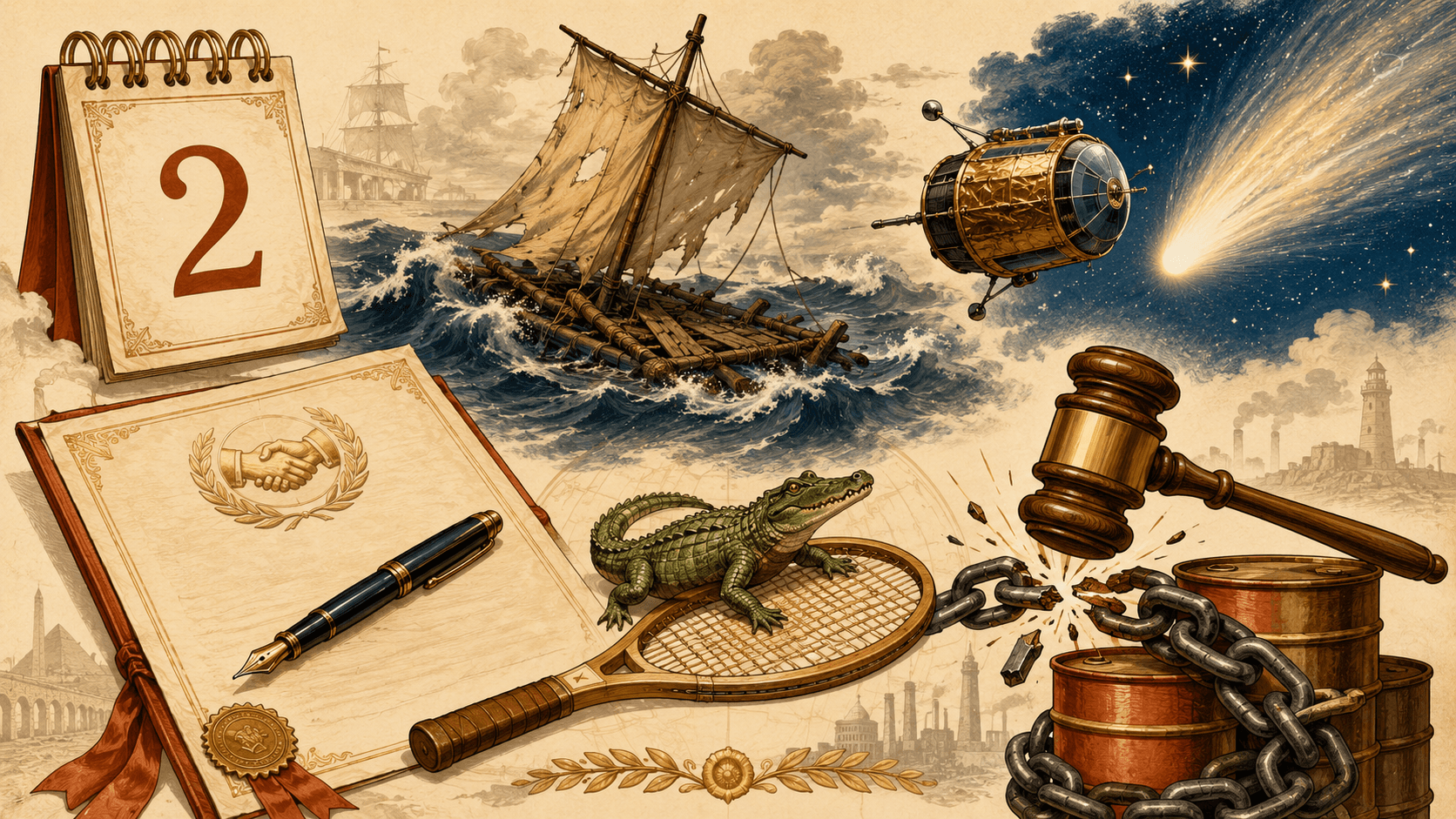
The 10 quiz questions
Question 1 : Which major civil rights event took place on July 2, 1964, in the United States?
Possible answers:
- The March on Washington
- The passage of the Civil Rights Act by Congress
- The abolition of segregation in schools
- The appointment of Thurgood Marshall to the Supreme Court
Explanation: The Civil Rights Act of 1964 was signed by President Lyndon B. Johnson. It banned discrimination based on race, color, religion, sex, or national origin. This piece of legislation is considered one of the great victories of the civil rights movement, led notably by Martin Luther King Jr.
Question 2 : Íngrid Betancourt, freed on July 2, 2008, had been held hostage by which organization?
Possible answers:
- The ELN (National Liberation Army)
- The Shining Path
- The FARC
- The Medellín cartels
Explanation: Íngrid Betancourt, a candidate for the presidency of Colombia, had been captured in February 2002 by the FARC (Revolutionary Armed Forces of Colombia). Her rescue, during Operation Jaque, was carried out without a single shot being fired by the Colombian army, which had infiltrated the ranks of the FARC.
Question 3 : The wreck of the ship La Méduse, which occurred on July 2, 1816, inspired a famous painting. Which painter created it?
Possible answers:
- Eugène Delacroix
- Jacques-Louis David
- Théodore Géricault
- Jean-Auguste-Dominique Ingres
Explanation: Théodore Géricault painted The Raft of the Medusa between 1818 and 1819, two years after the tragedy. For this painting, now on display at the Louvre, he interviewed survivors and carried out anatomical studies in morgues. The painting implicitly denounced the incompetence of the royalist captain appointed through political favoritism.
Question 4 : Born on July 2, 1877, the writer Hermann Hesse received the Nobel Prize in Literature in which year?
Possible answers:
- 1939
- 1946
- 1952
- 1958
Explanation: Hermann Hesse received the Nobel Prize in Literature in 1946, the same year he was also awarded the Goethe Prize. Born in Germany, he took Swiss nationality in 1923. His most famous novels include Siddhartha, Steppenwolf, and The Glass Bead Game, the work for which he notably received the Nobel.
Question 5 : Sam Walton opened his first Walmart store on July 2, 1962. In which American city did this happen?
Possible answers:
- Bentonville, Arkansas
- Rogers, Arkansas
- Little Rock, Arkansas
- Memphis, Tennessee
Explanation: The first Walmart opened in Rogers, Arkansas, Sam Walton's home state. Today, Walmart is the largest retail company in the world and one of the biggest private employers on the planet, with millions of employees. Its headquarters is still located in Bentonville, Arkansas.
Question 6 : On July 2, 1934, a French military institution was created. Which one?
Possible answers:
- The Foreign Legion
- The French Navy
- The French Air Force
- The National Gendarmerie
Explanation: The French Air Force was officially created on July 2, 1934, under the Third Republic. In 2020, it became the Air and Space Force (AAE), reflecting the growing importance of the space domain in modern military operations.
Question 7 : The philosopher Jean-Jacques Rousseau, who died on July 2, 1778, is associated with the Geneva Revolution of 1782. What was Rousseau's country of origin?
Possible answers:
- France
- Switzerland (Republic of Geneva)
- Netherlands
- Prussia
Explanation: Jean-Jacques Rousseau was born in Geneva in 1712. His political ideas, notably expressed in The Social Contract, deeply inspired the Geneva revolutionaries, which prompted the neighboring powers (France, Sardinia, and Bern) to intervene militarily to put an end to the revolution, fearing a contagion effect.
Question 8 : Born on July 2, 1904, René Lacoste is famous both for his sporting career and for founding an iconic brand. What was his nickname on the tennis courts?
Possible answers:
- The Lion
- The Tiger
- The Crocodile
- The Musketeer
Explanation: René Lacoste was nicknamed "the Crocodile," which directly inspired the logo of the brand he founded in 1933 with the clothing merchant André Gillier. He won seven Grand Slam tournaments between 1925 and 1929. His polo-collar shirt, designed for the comfort of tennis players, became a worldwide fashion icon.
Question 9 : The Giotto probe, launched on July 2, 1985, had as its main mission the study of which comet?
Possible answers:
- Comet Hale-Bopp
- Halley's Comet
- Comet Churyumov-Gerasimenko
- Comet Shoemaker-Levy
Explanation: The European Space Agency's Giotto probe was the first probe to photograph a comet's nucleus up close. It approached to within about 596 km of Halley's Comet nucleus in March 1986. Halley's Comet, visible from Earth roughly every 75 to 76 years, has been observed and documented by humans since antiquity.
Question 10 : The Sherman Antitrust Act, passed on July 2, 1890, is a foundational American law. What was this law primarily aimed at?
Possible answers:
- Labor unions
- Economic immigration
- Monopolies and anti-competitive practices
- Unfair foreign trade practices
Explanation: The Sherman Antitrust Act was the first U.S. federal law aimed at fighting monopolies and anticompetitive practices. It was notably used to break up John D. Rockefeller's oil trust (Standard Oil) in 1911. This law remains one of the pillars of competition law in the United States today.

