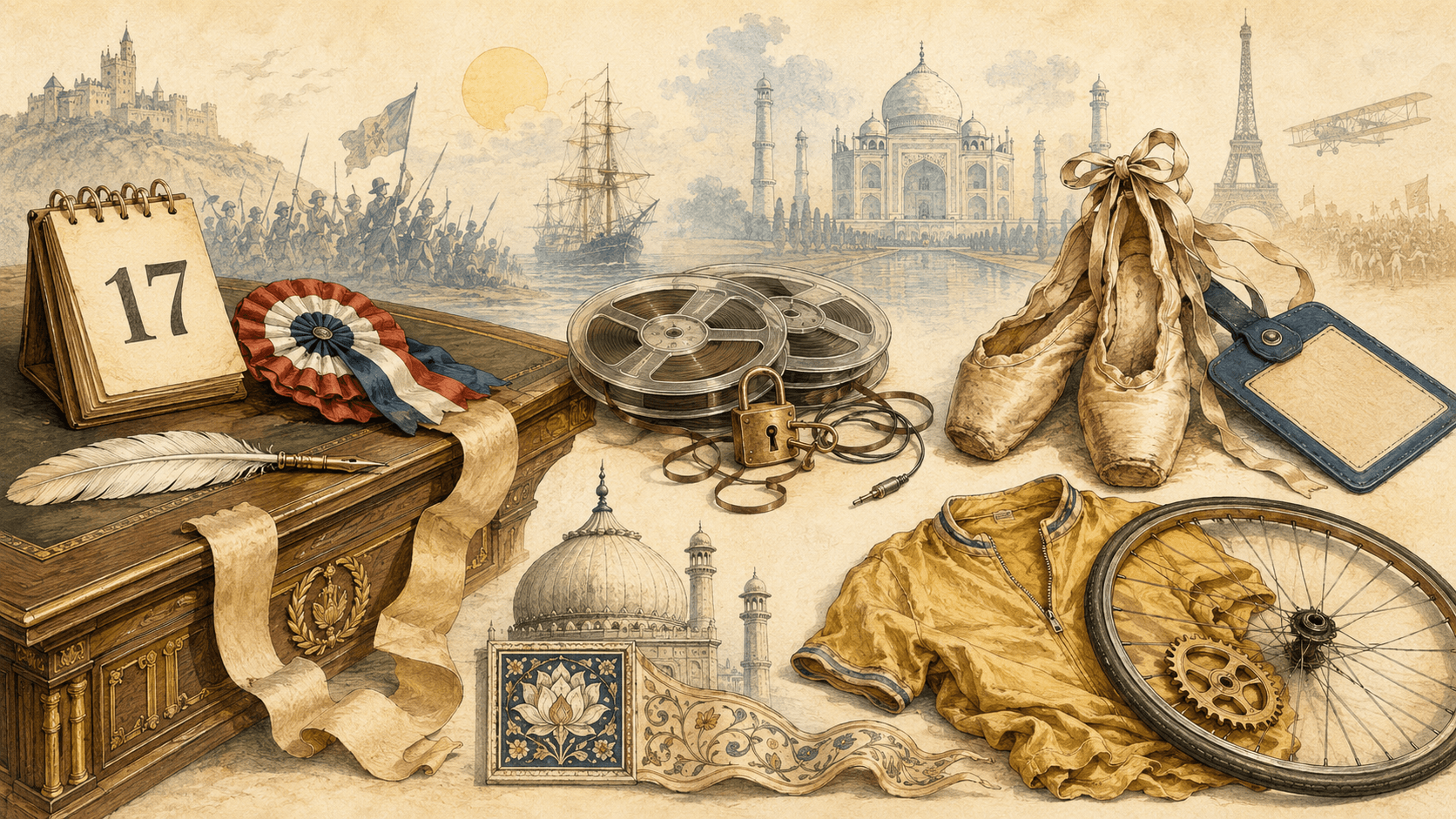
The 10 quiz questions
Question 1 : Which major event took place in France on June 17, 1789?
Possible answers:
- The storming of the Bastille by the people of Paris
- The proclamation of the French Republic
- The Estates General transform into the National Assembly
- The execution of Louis XVI on the Place de la Révolution
Explanation: The transformation of the Estates-General into the National Assembly on June 17, 1789, is considered the founding act of the French Revolution. Three days later, on June 20, the deputies swore the famous Tennis Court Oath, refusing to disband until a constitution had been adopted.
Question 2 : On June 17, 1972, five men were arrested at the Watergate complex. Which political party were they trying to spy on?
Possible answers:
- The Republican Party
- The Democratic Party
- The American Independent Party
- The Libertarian Party
Explanation: The Watergate scandal engulfed Republican president Richard Nixon, whose campaign team members had organized the break-in at the Democratic Party headquarters. Nixon ultimately resigned on August 9, 1974, the only U.S. president in history to have done so.
Question 3 : Which famous Soviet dancer requested political asylum at Le Bourget airport in June 1961?
Possible answers:
- Mikhail Baryshnikov
- Rudolf Nureyev
- Yuri Grigorovich
- Vladimir Vasiliev
Explanation: Rudolf Nureyev, principal dancer of the Kirov Ballet in Leningrad, refused to return to the USSR during a tour in France. His defection was a major event of the Cold War. He went on to become one of the most admired dancers in the world, notably partnering with Margot Fonteyn.
Question 4 : On June 17, 1940, Marshal Petain asked Germany for an armistice. What other dramatic war-related event took place at sea that same day?
Possible answers:
- The bombardment of the French fleet at Mers-el-Kébir
- The sinking of the liner Lancastria, killing thousands
- The destruction of the port of Bordeaux by the German army
- The torpedoing of a British submarine in the Mediterranean
Explanation: The sinking of the Lancastria off Saint-Nazaire on June 17, 1940, remains the worst maritime disaster in British history. Despite the scale of the tragedy, Churchill had the news censored to avoid further demoralizing British public opinion, already shaken by Dunkirk.
Question 5 : The famous Battle of Bunker Hill, linked to the American War of Independence, took place on June 17 of which year?
Possible answers:
- 1775
- 1776
- 1781
- 1783
Explanation: The Battle of Bunker Hill, which actually took place mostly on Breed's Hill near Boston, was one of the first major battles of the American Revolution. Although the British took the hill, they suffered heavy losses (around 1,000 soldiers), showing that the colonial militias could stand up to the regular army.
Question 6 : Born on June 17, 1882, Igor Stravinsky is one of the most influential composers of the 20th century. Which work made him famous starting in 1913?
Possible answers:
- Swan Lake
- The Rite of Spring
- Symphonie fantastique
- Peer Gynt
Explanation: The Rite of Spring, premiered on May 29, 1913, at the Theatre des Champs-Elysees, sparked a notorious scandal at its opening night: the audience split so violently that the performance descended into a near-riot in the hall. This revolutionary work is now seen as a major turning point in the history of classical music.
Question 7 : On June 17, 1631, the wife of Mughal emperor Shah Jahan died, inspiring the construction of a world-famous monument. Which monument is it?
Possible answers:
- The Red Fort of Delhi
- The Fatehpur Sikri palace
- The Taj Mahal
- Humayun's Tomb
Explanation: Arjumand Banu Begam, nicknamed Mumtaz Mahal (the light of the palace), died giving birth to her fourteenth child. Shah Jahan had the Taj Mahal built in Agra in her memory, a masterpiece of Mughal architecture that took about 22 years to complete and required more than 20,000 workers.
Question 8 : On June 17, 1944, Iceland proclaimed itself a republic. Which country had it previously been under?
Possible answers:
- Norway
- Denmark
- Sweden
- The United Kingdom
Explanation: Iceland had been under Danish rule since the late 14th century. When Nazi Germany occupied Denmark in 1940, Iceland gained more and more autonomy, before proclaiming itself an independent republic on June 17, 1944. The date is now Iceland's national day, chosen in reference to the birthday of national hero Jon Sigurdsson, born on a June 17.
Question 9 : Eddy Merckx, born on June 17, 1945, is considered one of the greatest cyclists in history. What nickname was he given because of his exceptional record?
Possible answers:
- The Lion of Flanders
- The Cannibal
- The Bird of Prey
- The Eagle of Brussels
Explanation: Eddy Merckx won the Tour de France five times, the Giro d'Italia five times, and the Vuelta a Espana once. His nickname, the Cannibal, was given to him because he left nothing for the other riders, winning absolutely everything he could. He still holds the record for the most stage wins at the Tour de France with 34 victories.
Question 10 : The Spanish Reconquista refers to the recapture of the Iberian Peninsula from which occupying people?
Possible answers:
- The Vikings
- The Visigoths
- The Moors
- The Byzantines
Explanation: The Moors, a term referring to the Berber and Arab Muslims who came from North Africa, had conquered nearly the entire Iberian Peninsula by 711. The Reconquista stretched over nearly eight centuries and ended in 1492 with the capture of Granada by the Catholic Monarchs Isabella and Ferdinand, the same year Christopher Columbus reached the Americas.

