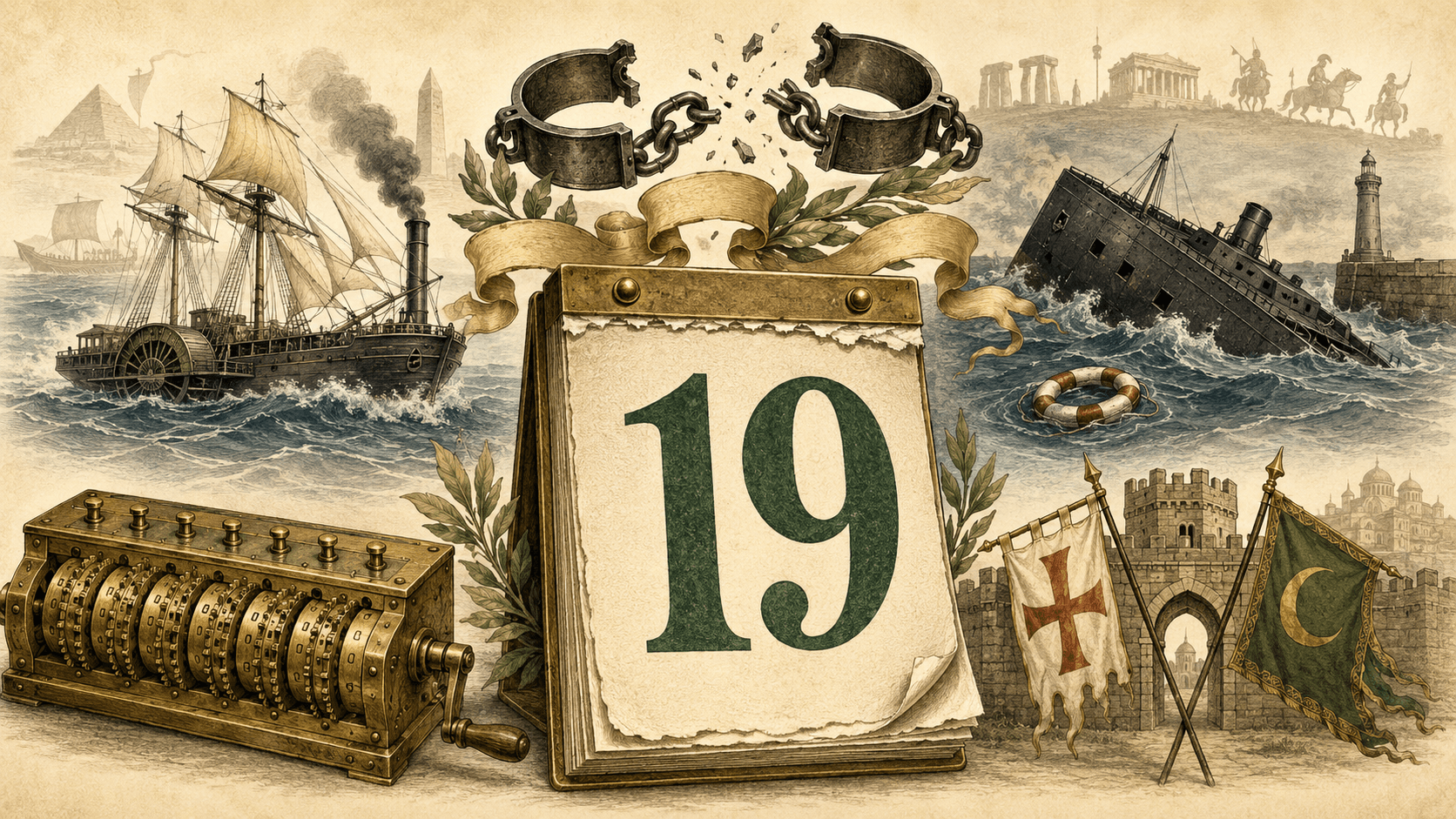
The 10 quiz questions
Question 1 : Which major event is commemorated in the United States under the name Juneteenth?
Possible answers:
- The end of the Civil War
- The announcement of the abolition of slavery in Texas
- The signing of the U.S. Constitution
- The release of Southern political prisoners
Explanation: Juneteenth gets its name from the blend of June and nineteenth. The announcement reached Texas on June 19, 1865, two and a half years after Lincoln's Emancipation Proclamation in 1863 because the news arrived so late. Juneteenth became a federal holiday in the United States in 2021.
Question 2 : Which historic Atlantic crossing did the American ship Savannah complete, arriving in Liverpool on June 19, 1819?
Possible answers:
- First non-stop transatlantic crossing
- First transatlantic crossing by a steamship
- First transatlantic crossing by a submarine
- First transatlantic crossing in under 10 days
Explanation: The Savannah was the first ship to use steam to cross the Atlantic, but it ran its steam paddle wheels for only part of the voyage (about 80 hours out of 27 days). It was mainly sail-powered. This crossing opened the era of transatlantic steam navigation, which would revolutionize trade and intercontinental travel.
Question 3 : Which agreement on the free movement of people was signed on June 19, 1990, and in which town?
Possible answers:
- The Maastricht Treaty, signed in Maastricht
- The Schengen Convention, signed in Schengen, Luxembourg
- The Treaty of Rome, signed in Rome
- The Brussels Agreement, signed in Brussels
Explanation: The 1990 Schengen Convention rounded out the original 1985 agreement signed in the same small Luxembourgish town. It laid down the practical rules for abolishing checks at internal borders. The Schengen Area now includes 29 member states and represents one of the most concrete achievements of European integration for ordinary citizens.
Question 4 : On June 19, 1864, the CSS Alabama was sunk in a naval battle. Off which French city did this battle take place?
Possible answers:
- Brest
- Le Havre
- Cherbourg
- Calais
Explanation: The CSS Alabama was a fearsome Confederate cruiser that had sunk or captured more than 60 Union ships in less than two years. Its defeat by the USS Kearsarge off Cherbourg ended one of the most spectacular commerce-raiding campaigns in American naval history. The battle was watched from the cliffs by many onlookers, including the Impressionist painter Édouard Manet.
Question 5 : Blaise Pascal, born on June 19, 1623, is a major figure of the 17th century. In which field did he NOT make a notable contribution?
Possible answers:
- Mathematics and probability
- Sculpture and visual arts
- Physics and atmospheric pressure
- Philosophy and theology
Explanation: Pascal was one of the most versatile geniuses in history. He invented the first mechanical calculator (the Pascaline), formulated the laws of atmospheric pressure and hydraulics, developed probability theory with Fermat, and wrote the famous Pensées, a masterpiece of philosophical and apologetic literature. Sculpture, on the other hand, was outside his work.
Question 6 : On June 19, 1991, Pablo Escobar surrendered to the Colombian authorities under what main condition?
Possible answers:
- The assurance of never being extradited to the United States
- The guarantee of serving his sentence in a Colombian prison of his choice
- A full amnesty for his past crimes
- Protection of his family by the Colombian government
Explanation: Pablo Escobar negotiated his surrender by securing a guarantee that he would not be extradited to the United States, where he faced very harsh sentences. He was held in a luxury prison he had built himself, nicknamed La Catedral, from which he escaped in July 1992. He was eventually shot dead by Colombian special forces on December 2, 1993, in Medellín.
Question 7 : Which Soviet space mission set a duration record for crewed flight, landing in Kazakhstan on June 19, 1970?
Possible answers:
- Soyuz 11
- Mir 3
- Vostok 5
- Soyuz 9
Explanation: Soyuz 9, with cosmonauts Andriyan Nikolayev and Vitaly Sevastyanov on board, set a record of 17 days, 16 hours, and 59 minutes in space. The record was partly driven by the Soviet desire to show they could keep cosmonauts in orbit, in the context of the space race with the United States. Both cosmonauts had a hard time readjusting to gravity on their return.
Question 8 : The 1990 Schengen Convention initially covered free movement between which countries?
Possible answers:
- France, Germany, Italy and Spain
- France, Germany and the Benelux countries
- France, the United Kingdom and Germany
- Germany, Austria, Switzerland and Luxembourg
Explanation: The 1990 convention initially involved France, the Federal Republic of Germany, and the three Benelux countries (Belgium, the Netherlands, Luxembourg). These five countries had already signed a preliminary agreement in 1985. The Schengen Area has gradually expanded to include nearly all European Union countries today, plus several non-member states such as Switzerland, Norway, and Iceland.
Question 9 : In what historical context did Kuwait gain independence on June 19, 1961?
Possible answers:
- After a popular revolution against the monarchy
- Following the abolition of the 1899 British protectorate treaty
- Following the UN resolution on the decolonisation of the Middle East
- After military victory over Ottoman forces
Explanation: Kuwait had been under British protectorate since the 1899 treaty, which had been concluded to protect the emirate from Ottoman and German ambitions. Its independence was quickly threatened by Iraqi territorial claims, which pushed Kuwait to join the Arab League and call on British troops for its defense. Iraq would revive its ambitions over Kuwait by invading it in 1990.
Question 10 : The First Crusade is a major event of the Middle Ages. Which city was taken from the Seljuk Turks on June 19, 1097, during the siege that marked one of the first Crusader victories?
Possible answers:
- Antioch
- Nicaea
- Edessa
- Constantinople
Explanation: Nicaea (now İznik, in Turkey) was the capital of the Sultanate of Rum. Its capture was the first major Crusader victory, but the city was actually handed over to the Byzantines rather than to the Crusaders themselves, which created tensions between the allies. The First Crusade ended in 1099 with the capture of Jerusalem and the founding of the kingdom of the same name.

