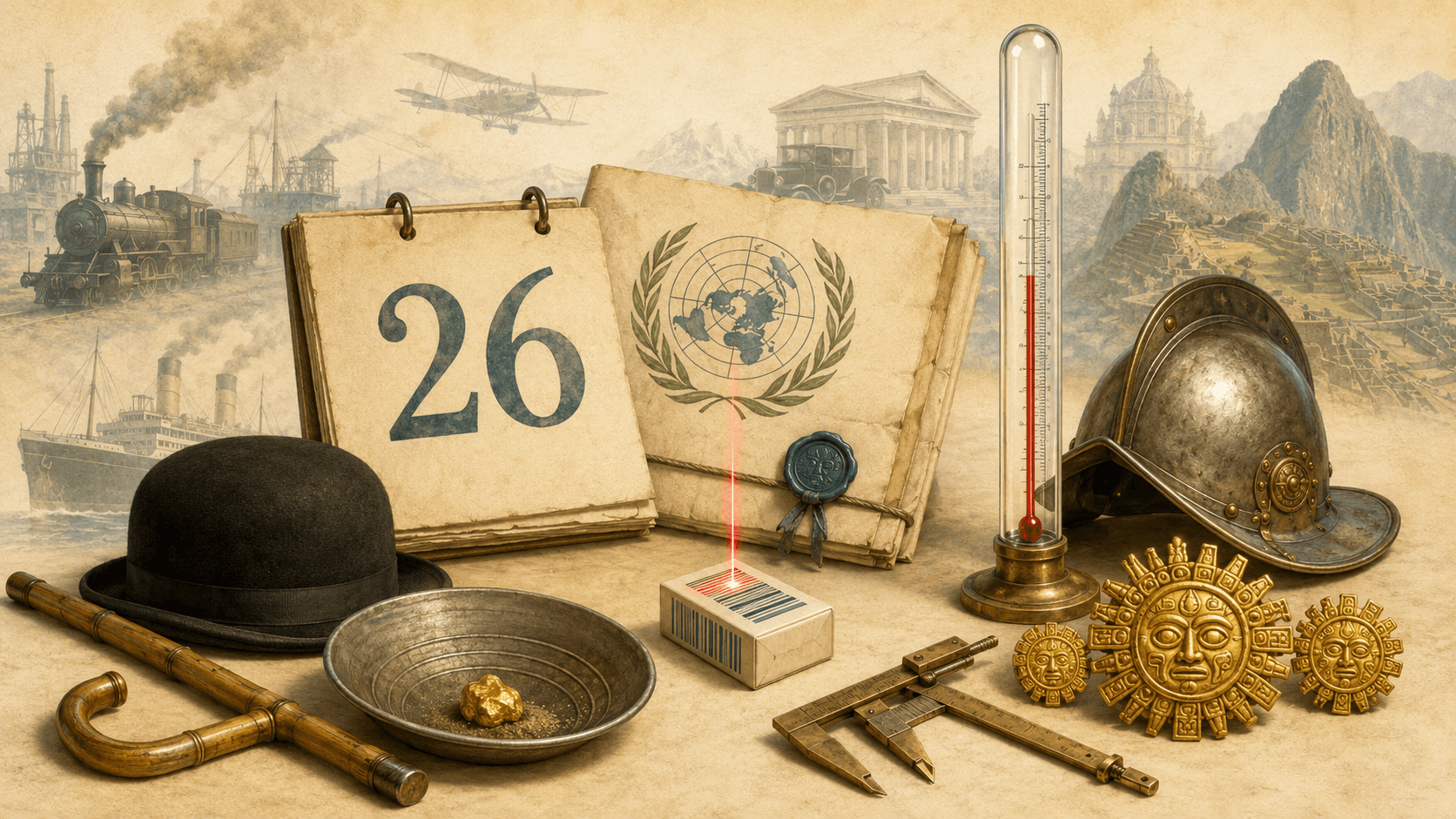
The 10 quiz questions
Question 1 : What famous phrase did John F. Kennedy deliver during his visit to Berlin on June 26, 1963?
Possible answers:
- "We shall overcome"
- "Ich bin ein Berliner"
- "Tear down this wall"
- "Ask not what your country can do for you"
Explanation: This speech was delivered before a crowd of more than 400,000 people at the West Berlin City Hall (Schöneberg). Kennedy wanted to express American solidarity with the people of West Berlin, who had been separated since 1961 by the Berlin Wall.
Question 2 : What major event in the field of international law took place on June 26, 1945?
Possible answers:
- The signing of the Universal Declaration of Human Rights
- The creation of the International Court of Justice
- The adoption of the United Nations Charter
- The signing of the peace treaty ending the Second World War
Explanation: The Charter of the United Nations was signed in San Francisco by 50 founding nations. It came into force on October 24, 1945, a date commemorated every year as United Nations Day. Today, the UN has 193 member states.
Question 3 : Which African country gained its independence on June 26, 1960?
Possible answers:
- Senegal
- Congo
- Ivory Coast
- Madagascar
Explanation: Madagascar, a former French colony, became the Malagasy Republic on June 26, 1960. This date is now a national holiday in Madagascar. The island is the fourth largest in the world and is home to exceptional biodiversity with many endemic species.
Question 4 : What was the first product with a barcode to be scanned at a checkout on June 26, 1974?
Possible answers:
- A can of Campbell's soup
- A pack of Wrigley chewing gum
- A can of Coca-Cola
- A box of Kellogg's cereal
Explanation: The first scan of a barcode in real commercial conditions took place at a Marsh supermarket in Troy, Ohio. The barcode used was the UPC standard (Universal Product Code). This technology revolutionized inventory management and retail around the world.
Question 5 : Which famous Charlie Chaplin film was released on June 26, 1925?
Possible answers:
- Modern Times
- The Kid
- The Gold Rush
- The Great Dictator
Explanation: The Gold Rush is considered one of the greatest masterpieces of silent cinema. Chaplin himself named it as the film he most wanted to be remembered for. It draws inspiration from the Klondike Gold Rush of 1896-1899 and contains iconic scenes such as the dancing bread rolls.
Question 6 : What major scientific event took place for the first time during the Battle of Fleurus in 1794?
Possible answers:
- The first use of a long-range cannon
- The first military use of an observation balloon
- The first use of modern gunpowder
- The first use of an optical telegraph in the field
Explanation: The balloon used at Fleurus was called the Entreprenant and was piloted by Captain Coutelle. This aerial observation allowed French troops to monitor enemy movements and contributed to their victory. This battle, won against the Austro-Dutch coalition, allowed France to conquer Belgium.
Question 7 : On June 26, 1948, what historic operation began to counter the Soviet blockade?
Possible answers:
- Operation Market Garden
- The Berlin Airlift
- The Normandy landings
- Operation Overlord
Explanation: The Berlin Airlift was organized by the Western Allies after the Soviets blocked all land access to West Berlin. It lasted until May 12, 1949, and required more than 200,000 flights to supply the city with food, coal, and other essential goods.
Question 8 : Which famous Caribbean poet and politician, a key figure of the Négritude movement, was born on June 26, 1913?
Possible answers:
- Frantz Fanon
- Édouard Glissant
- Patrick Chamoiseau
- Aimé Césaire
Explanation: Aimé Césaire was not only a poet (author of the famous Notebook of a Return to the Native Land), but also mayor of Fort-de-France for 56 years and a member of parliament for Martinique. Along with Léopold Sédar Senghor and Léon-Gontran Damas, he is one of the founders of the literary and political Négritude movement.
Question 9 : Which British physicist, born on June 26, 1824, gave his name to a unit of temperature measurement?
Possible answers:
- Lord Kelvin
- James Prescott Joule
- Michael Faraday
- James Clerk Maxwell
Explanation: William Thomson, known by the title Lord Kelvin, established the absolute temperature scale that bears his name. Zero kelvin (-273.15 °C) corresponds to absolute zero, the lowest temperature theoretically possible. His work was also fundamental in establishing the laws of thermodynamics.
Question 10 : Which Spanish conquistador, famous for conquering the Inca Empire, was assassinated on June 26, 1541?
Possible answers:
- Hernán Cortés
- Francisco Pizarro
- Vasco da Gama
- Pedro de Valdivia
Explanation: Francisco Pizarro was killed in Lima by supporters of Diego de Almagro the Younger, his former ally whom he had executed. Pizarro had conquered Peru with only a handful of soldiers thanks to the strategy of capturing the Inca Atahualpa, obtaining a colossal ransom in gold and silver before having him executed in 1533.

