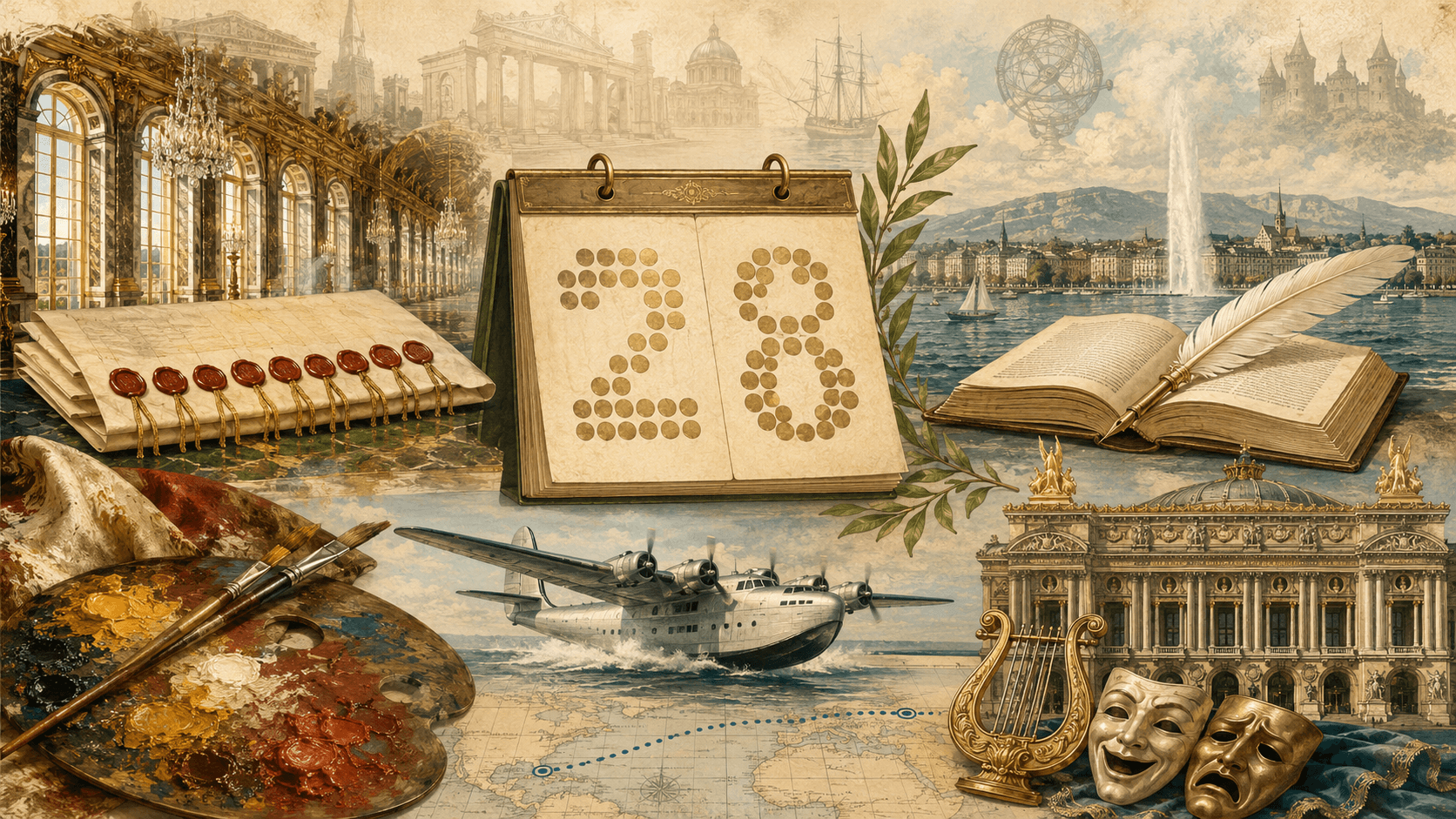
The 10 quiz questions
Question 1 : What event on June 28, 1914, in Sarajevo triggered the outbreak of World War I?
Possible answers:
- The assassination of Kaiser Wilhelm II
- The assassination of Archduke Franz Ferdinand of Austria
- Serbia's declaration of war on Austria
- The occupation of Sarajevo by Austro-Hungarian troops
Explanation: Archduke Franz Ferdinand, heir to the Austro-Hungarian throne, was assassinated along with his wife Sophie by Gavrilo Princip, a Bosnian Serb nationalist. This act set off a chain of ultimatums and mobilizations that led to World War I within weeks.
Question 2 : The Treaty of Versailles, signed on June 28, 1919, ended which war?
Possible answers:
- The Franco-Prussian War
- The Second World War
- The First World War
- The Balkan War
Explanation: The Treaty of Versailles was signed exactly five years after the assassination of Franz Ferdinand, in the Hall of Mirrors at the Palace of Versailles. It imposed colossal war reparations and territorial losses on Germany, conditions that contributed to the political instability leading to World War II.
Question 3 : Which major Enlightenment philosopher was born on June 28, 1712, in Geneva?
Possible answers:
- Voltaire
- Denis Diderot
- Montesquieu
- Jean-Jacques Rousseau
Explanation: Jean-Jacques Rousseau, born in Geneva, is the author of The Social Contract and Emile, or On Education, two foundational works of modern political and educational philosophy. His thought deeply influenced the French Revolution and contemporary democracies.
Question 4 : On June 28, 1969, the Stonewall riots in New York are considered the starting point of which movement?
Possible answers:
- The civil rights movement of Black Americans
- The LGBT Pride march
- The feminist movement for abortion rights
- The movement against the Vietnam War
Explanation: The Stonewall riots broke out after a police raid on the Stonewall Inn bar on Christopher Street. The resistance of the patrons, mostly LGBT, marked a turning point in the struggle for the rights of gay and transgender people, giving rise to the first pride marches the following year.
Question 5 : Louis XIV founded the Royal Academy of Music on June 28, 1669; under what name is this institution known today?
Possible answers:
- The Paris Conservatory of Music
- The Comédie-Française
- The Paris Opera
- The Opéra-Comique National Theater
Explanation: The Royal Academy of Music, founded by letters patent of Louis XIV, became the Paris National Opera, one of the most prestigious cultural institutions in the world. It notably runs the Palais Garnier, inaugurated in 1875, and the Opéra Bastille, opened in 1989.
Question 6 : In 1926, two car manufacturers merged on June 28 to create an iconic brand. Which merger was it?
Possible answers:
- Renault and Peugeot
- Daimler Motoren Gesellschaft and Benz & Cie
- BMW and Volkswagen
- Opel and Ford Germany
Explanation: The merger of Daimler Motoren Gesellschaft and Benz & Cie gave birth to Mercedes-Benz AG, whose name combines the first name of the daughter of an important Daimler client, Mercedes Jellinek, and the surname of inventor Karl Benz. This alliance created one of the most influential car groups in history.
Question 7 : Which Flemish painter, famous for his Baroque works, was born on June 28, 1577?
Possible answers:
- Jan Vermeer
- Rembrandt van Rijn
- Peter Paul Rubens
- Hieronymus Bosch
Explanation: Peter Paul Rubens, born in Siegen, Westphalia, is one of the greatest masters of Baroque painting. He created monumental works for the royal courts of Europe, notably the cycle of paintings dedicated to Marie de Medici, kept at the Louvre. He excelled in mythological and religious scenes and in portraits.
Question 8 : The Battle of Kosovo Polje, which took place on June 28, 1389, pitted Ottoman forces against which Christian armies?
Possible answers:
- The Hungarian and Austrian armies
- The forces of the Serbian-Balkan coalition
- The Teutonic Knights and the Crusaders
- The Byzantine and Venetian armies
Explanation: The Battle of Kosovo Polje ("field of blackbirds") pitted the Ottomans of Sultan Murad I against a Christian coalition led by the Serbian prince Lazar Hrebeljanović. This defeat marked the beginning of Ottoman domination in the Balkans and remained etched in Serbian collective memory as a founding event, still commemorated as a national day.
Question 9 : In 1939, Pan American Airways launched the first regular transatlantic passenger service aboard a Boeing 314. Which route did it serve?
Possible answers:
- New York to Paris
- New York to Marseille
- Chicago to London
- Boston to Lisbon
Explanation: The Boeing 314, nicknamed the "Dixie Clipper," was a large flying boat capable of crossing the Atlantic. This inaugural flight linked New York to Marseille via Lisbon, opening a new era in international commercial air travel and considerably reducing transatlantic travel time compared to ocean liners.
Question 10 : Muhammad Yunus, born on June 28, 1940, is a Nobel Peace Prize laureate for his work on microcredit. In which country did he develop his microfinance system?
Possible answers:
- In India
- In Bangladesh
- In Pakistan
- In Sri Lanka
Explanation: Muhammad Yunus founded the Grameen Bank in Bangladesh in 1983, a pioneering institution in providing small unsecured loans to very poor people, particularly rural women. His model has since been replicated in many developing countries and has transformed the approach to fighting poverty worldwide.

