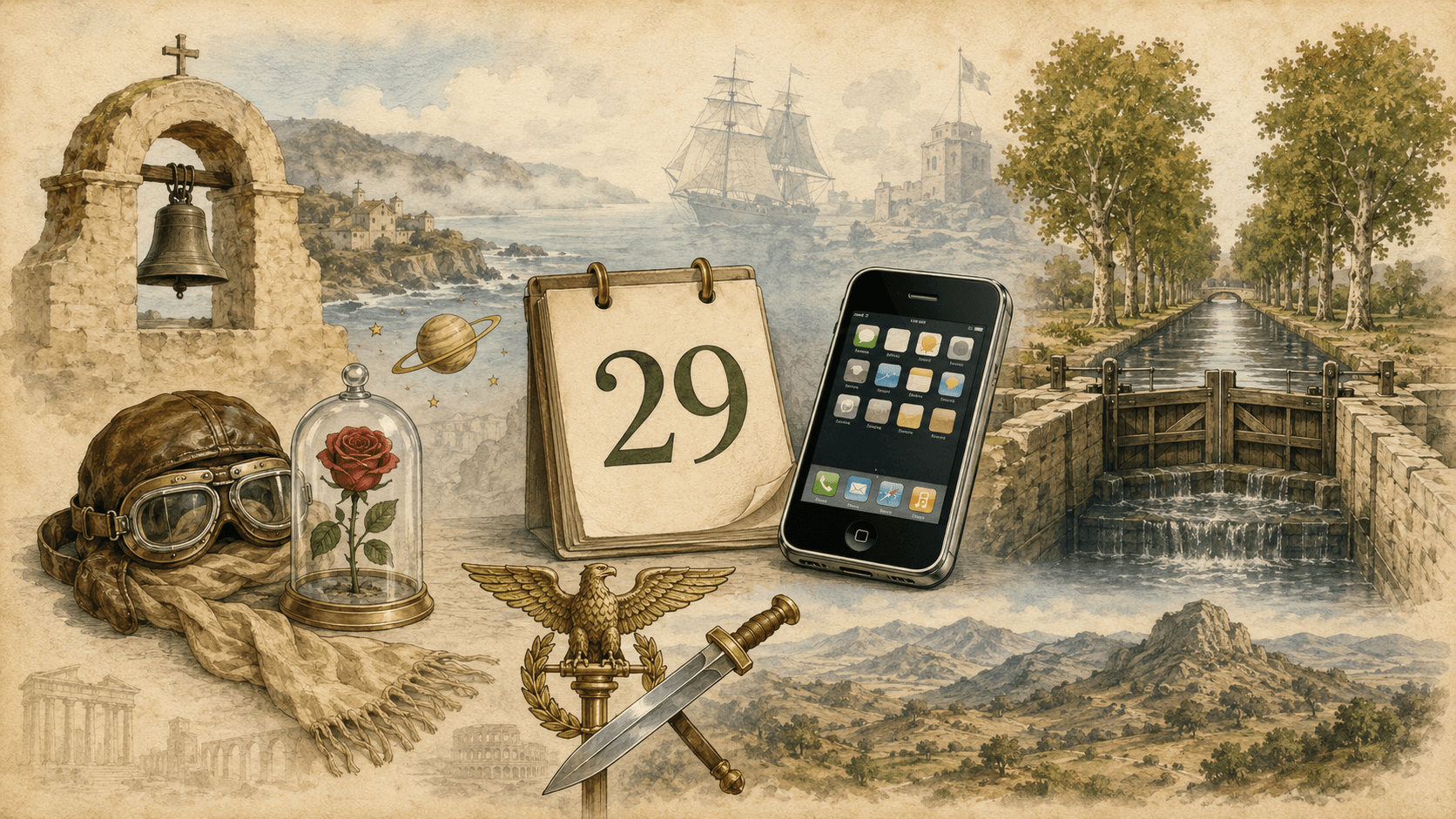
The 10 quiz questions
Question 1 : Which city was founded on June 29, 1776, by Father Francisco Palou?
Possible answers:
- Los Angeles
- San Diego
- San Francisco
- Santa Barbara
Explanation: The founding of San Francisco began with the establishment of a Franciscan mission, Mission Dolores, officially named Mission San Francisco de Asís. The city only truly took off after the California Gold Rush of 1848-1849, becoming one of the major metropolises of the West Coast.
Question 2 : Which major technological event happened on June 29, 2007?
Possible answers:
- Launch of the first civilian GPS satellite
- Release of the first iPhone model
- Creation of Facebook
- Launch of the first touchscreen tablet
Explanation: The release of the first iPhone by Apple revolutionized the telecommunications industry. Steve Jobs had introduced it in January 2007 as "an iPod with a phone and an Internet communicator." The lines outside Apple Stores made headlines around the world, marking the start of the modern smartphone era.
Question 3 : Born on June 29, 1886, Robert Schuman is best known for which historical role?
Possible answers:
- He was the first president of the French Fifth Republic
- He was one of the founding fathers of the European Union
- He led the French Resistance during the Second World War
- He was the first Secretary-General of the UN
Explanation: Robert Schuman authored the declaration of May 9, 1950, which proposed the creation of the European Coal and Steel Community (ECSC), the first building block of European integration. That date is celebrated today as Europe Day. Born in Luxembourg, he was both a politician from Lorraine and one of the architects of Franco-German reconciliation.
Question 4 : Which island did France annex on June 29, 1880?
Possible answers:
- Réunion
- Martinique
- Tahiti
- New Caledonia
Explanation: France's annexation of Tahiti in 1880 ended the Kingdom of Tahiti, whose last queen was Pomare V, who abdicated that year. Tahiti had already been a French protectorate since 1842. Today it is the heart of French Polynesia, an overseas collectivity whose capital is Papeete.
Question 5 : Which French writer, author of The Little Prince, was born on June 29, 1900?
Possible answers:
- Albert Camus
- Antoine de Saint-Exupéry
- André Malraux
- Frédéric Dard
Explanation: Antoine de Saint-Exupéry, born in Lyon, was also an airline and wartime pilot. He disappeared on July 31, 1944, during a reconnaissance mission over the Mediterranean. The remains of his aircraft, a P-38 Lightning, were found at sea in 2000. The Little Prince, published in 1943, is one of the most translated books in the world.
Question 6 : On June 29, 1973, a major political event shook Chile. What was it?
Possible answers:
- The assassination of President Salvador Allende
- An attempted military coup known as the Tanquetazo
- The announcement of early elections by Allende
- The nationalization of Chilean copper mines
Explanation: The Tanquetazo (or Tancazo) was an attempted coup led by the No. 2 armored regiment against the socialist government of Salvador Allende. It failed but foreshadowed the military coup of September 11, 1973, led by General Augusto Pinochet, who overthrew Allende and caused his death.
Question 7 : Pierre-Paul Riquet, born on June 29, 1609, is famous for building which great structure in France?
Possible answers:
- The Canal du Midi
- The Palace of Versailles
- The Millau Viaduct
- The Briare Canal
Explanation: The Canal du Midi, built between 1667 and 1694, links the Garonne to the Mediterranean Sea over about 240 km. Riquet died six months before its inauguration. A UNESCO World Heritage Site since 1996, it remains one of the greatest masterpieces of hydraulic engineering of the 17th century, featuring more than 300 structures.
Question 8 : Which country gained its independence on June 29, 1976?
Possible answers:
- The Comoros
- The Seychelles
- Mauritius
- Djibouti
Explanation: The Seychelles, an Indian Ocean archipelago made up of 115 islands, became an independent republic on June 29, 1976, after being a British colony. France-Albert René overthrew the first president, James Mancham, the following year in a coup. Victoria is the capital of this archipelago, one of the smallest states in Africa.
Question 9 : In which field did Lucie Aubrac, born on June 29, 1912, especially distinguish herself?
Possible answers:
- 20th-century French literature
- The French Resistance during the Second World War
- France's foreign policy
- Women's rights in the European Parliament
Explanation: Lucie Aubrac and her husband Raymond Aubrac were among the most iconic figures of the French Resistance. She notably organized the spectacular escape of Raymond, arrested by Klaus Barbie in 1943. After the war, she became a teacher and a tireless campaigner for passing on the memory of the Resistance to younger generations.
Question 10 : At the Battle of Pharsalus, in 48 BC, Pompey was defeated by Julius Caesar. In which region did this decisive battle take place?
Possible answers:
- In Macedonia
- In Epirus
- In Thessaly
- In Boeotia
Explanation: The Battle of Pharsalus is one of the most important in Roman history. After his defeat, Pompey fled to Egypt, where he was assassinated on the orders of Pharaoh Ptolemy XIII, who hoped to win Caesar's favor. This victory allowed Caesar to cement his dominance over Rome and paved the way for the end of the Roman Republic.

