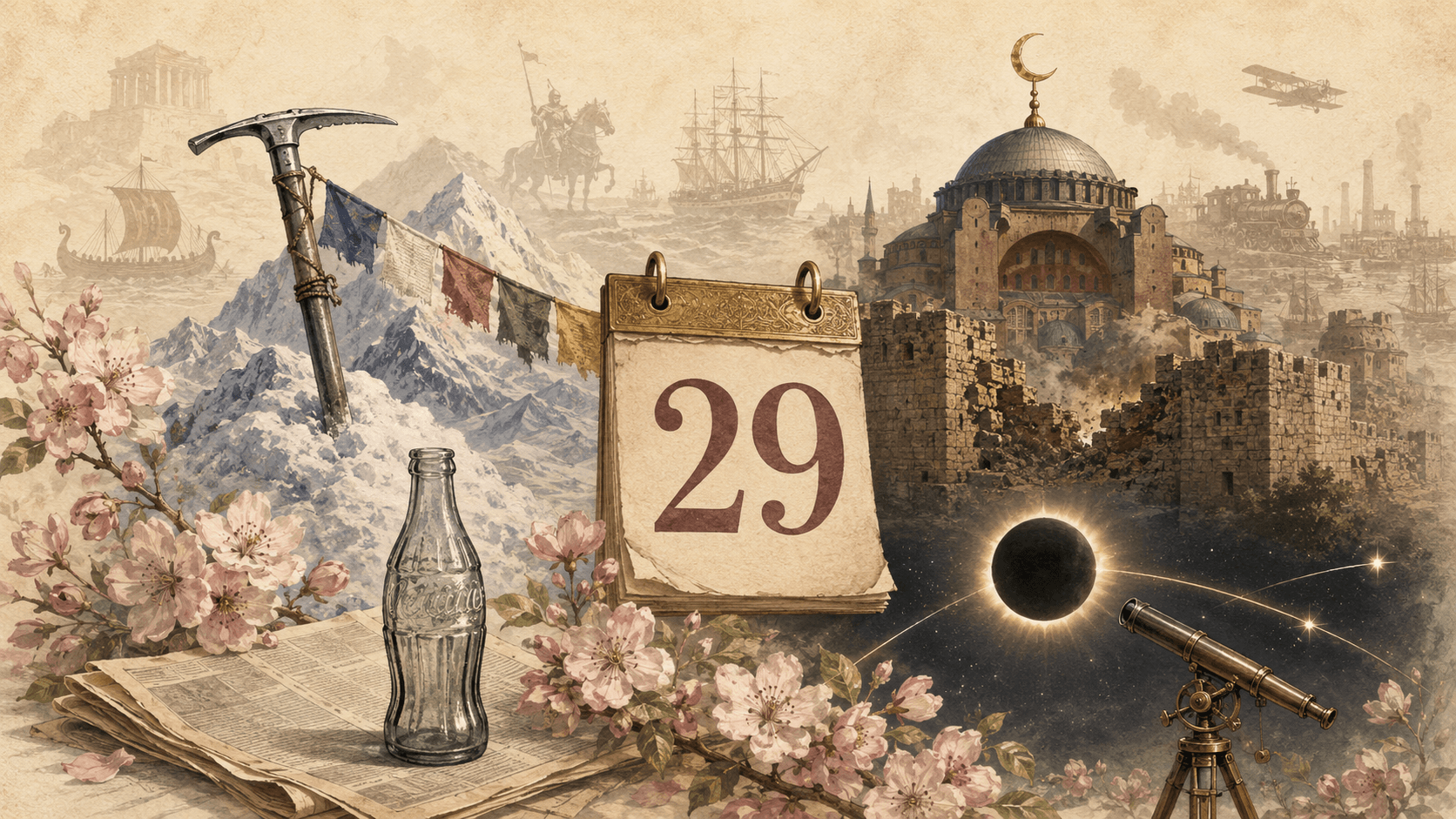
The 10 quiz questions
Question 1 : In what year did the first known ascent of Everest take place, by Edmund Hillary and Sherpa Tenzing Norgay?
Possible answers:
- 1948
- 1950
- 1953
- 1957
Explanation: The 1953 expedition was British, led by Colonel John Hunt. Hillary and Norgay reached the summit at 11:30 a.m. local time. The news was transmitted to London just in time for Queen Elizabeth II's coronation on 2 June 1953, making it a double historical event.
Question 2 : Which city was founded on 29 May 1900 by explorer Émile Gentil and bears another name today?
Possible answers:
- Brazzaville
- Bangui
- Yaoundé
- N'Djamena
Explanation: Fort-Lamy, founded at the confluence of the Chari and Logone rivers, was renamed N'Djamena in 1973 by Chadian president Ngarta Tombalbaye as part of an African authenticity policy. N'Djamena means 'place of rest' in local Arabic.
Question 3 : What tragic event occurred on 29 May 1985 at the King Baudouin Stadium in Brussels before the European Cup final?
Possible answers:
- A terrorist attack targeting the stands
- A stand collapse due to its dilapidation
- A tragedy caused by English hooligans killing dozens
- A brawl between police and Italian supporters
Explanation: The Heysel disaster killed 39 people, mostly Italian Juventus Turin supporters, after charges by English hooligans. Following the event, all English clubs were banned from European competitions for five years. Juventus won the match 1-0 thanks to a penalty goal by Michel Platini.
Question 4 : On what exact date did Constantinople fall, marking the end of the Byzantine Empire?
Possible answers:
- 29 May 1453
- 29 May 1389
- 29 May 1492
- 29 May 1415
Explanation: The fall of Constantinople on 29 May 1453 ended the Eastern Roman Empire, which had survived nearly a thousand years after the fall of Rome in 476. The city was taken by the troops of Ottoman sultan Mehmed II after a 53-day siege. The event is often considered the end of the Middle Ages.
Question 5 : Which major scientific theory was confirmed on 29 May 1919, during a solar eclipse observed by Arthur Eddington?
Possible answers:
- Darwin's theory of evolution
- Planck's quantum mechanics
- Albert Einstein's theory of general relativity
- Hubble's theory of the expansion of the universe
Explanation: Arthur Eddington observed from the island of Príncipe (Africa) that starlight was deflected by the Sun's gravitational field, confirming Einstein's general relativity. The experiment made headlines worldwide and made Einstein internationally famous, even though the theory had been published in 1915.
Question 6 : On 29 May 2005, the French rejected an important treaty by referendum. What was the subject of this text?
Possible answers:
- France's adhesion to the eurozone
- The establishment of a Constitution for Europe
- The enlargement of the European Union to the Baltic countries
- The creation of a common European tax
Explanation: The referendum of 29 May 2005 saw 'no' win with 54.67% of the votes, on a turnout of 69.34%. This rejection, followed by that of the Netherlands on 1 June, led to the abandonment of the European constitutional treaty. The essential elements of the text were partly reused in the Treaty of Lisbon, adopted without a referendum in France in 2007.
Question 7 : Which celebrity born on 29 May 1917 became the 35th president of the United States?
Possible answers:
- Franklin D. Roosevelt
- Harry Truman
- John F. Kennedy
- Lyndon B. Johnson
Explanation: John Fitzgerald Kennedy, born in Brookline, Massachusetts, is the youngest elected president in American history (43 years old) and the first Catholic to hold the office. His term, often called 'Camelot', was marked by the Cuban Missile Crisis and the beginnings of the Vietnam War. He was assassinated in Dallas on 22 November 1963.
Question 8 : In 1886, the first advertisement for a famous drink appeared in an American newspaper. What was this drink?
Possible answers:
- Pepsi-Cola
- Dr Pepper
- Coca-Cola
- Schweppes
Explanation: Coca-Cola was invented by pharmacist John Pemberton in Atlanta in 1886. The first advertisement appeared in the Atlanta Journal on 29 May 1886, only a few weeks after the drink went on sale. In its early days, Coca-Cola was sold in pharmacies as a remedy for headaches and nausea.
Question 9 : Which international organization was created in the wake of a UN Security Council resolution adopted on 29 May 1951?
Possible answers:
- The International Criminal Court
- The World Trade Organization
- UNESCO
- The International Court of Justice
Explanation: The International Court of Justice (ICJ), headquartered in The Hague, Netherlands, is the principal judicial organ of the United Nations. Founded in 1945 under the UN Charter, it settles legal disputes between states. The resolution of 29 May 1951 clarified its operating procedures. It should not be confused with the International Criminal Court (ICC), created in 2002.
Question 10 : The Lombard League, which defeated the Holy Roman Empire at the Battle of Legnano in 1176, was an alliance of cities in northern Italy. Which Germanic emperor was defeated in this battle?
Possible answers:
- Henry IV of the Holy Roman Empire
- Frederick I Barbarossa
- Otto IV of Brunswick
- Conrad III of Hohenstaufen
Explanation: Frederick I Barbarossa suffered at Legnano one of the rare defeats of his reign. This victory of the Lombard League was decisive for the autonomy of Italian cities and forced Barbarossa to sign the Peace of Constance in 1183, recognizing the communal liberties. The battle is today celebrated every year in Legnano with a great historical procession.

