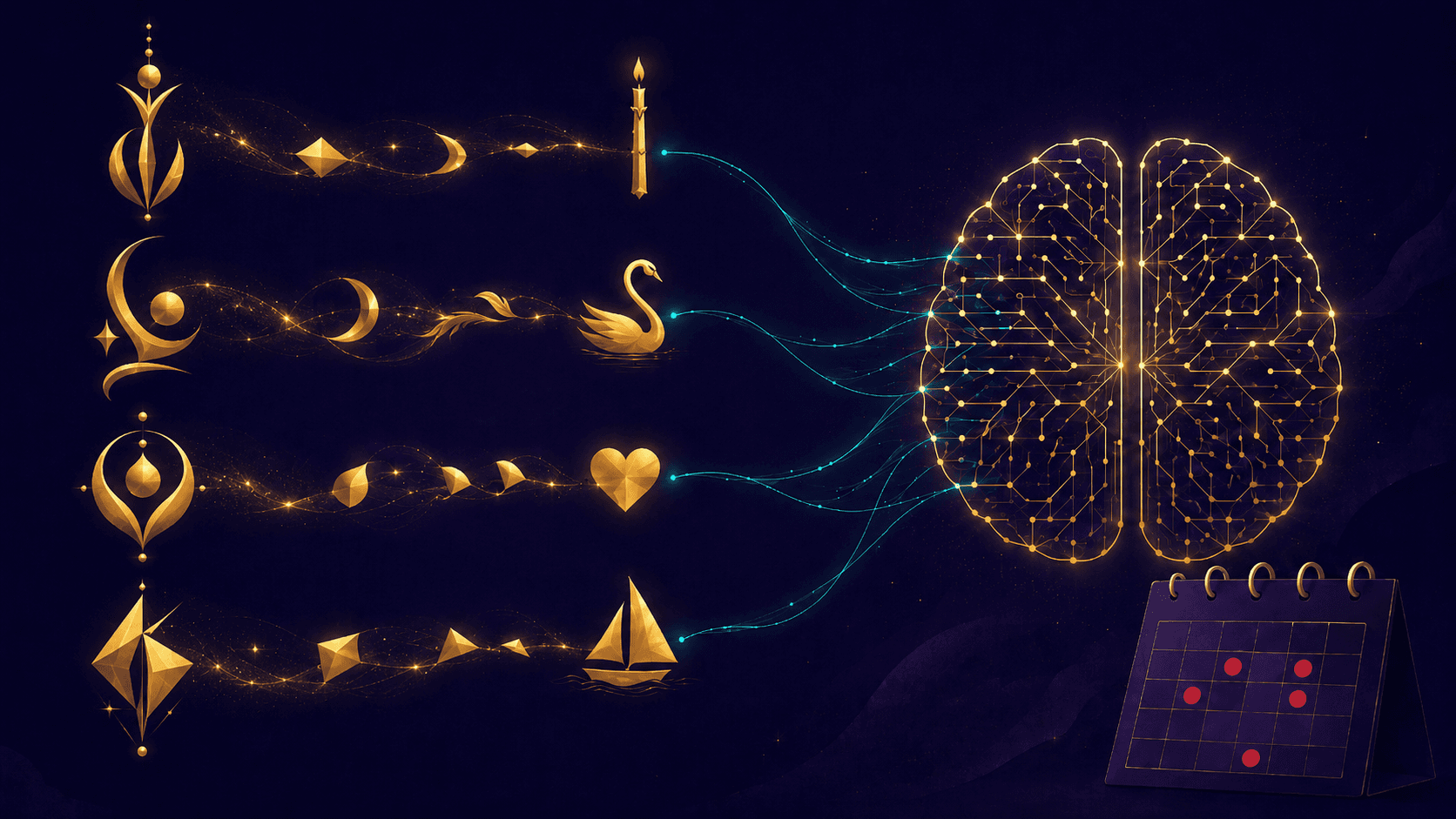
You know something important happened in 1789. But was it 1789 or 1792? And your dentist''s phone number that you knew by heart yesterday... vanished. Don''t panic: your brain isn''t broken, it''s just poorly equipped for what you''re asking.
Numbers are, by nature, abstract objects. No color, no smell, no emotion. Yet our brain loves anything sensory and visual. Fortunately, memory champions have spent centuries developing techniques that turn numbers into images, sounds, and stories. Once you master them, memorizing a date or a number becomes almost... fun.
Why Our Brain Hates Abstract Numbers
Our brain evolved to remember faces, paths, dangers, emotions. Not strings of digits. When you try to memorize "1492," you''re juggling four arbitrary symbols with no sensory anchor. Result: the memory trace is weak and fades fast.
Numbers suffer from three major handicaps:
- No mental image: impossible to "see" 7 or 92.
- No emotion: a number doesn''t make you laugh, fear, or dream.
- High similarity: 1789, 1792, 1793 look almost identical.
The solution? Convert the abstract into the concrete. The techniques below do exactly that.
Chunking: Group to Remember Better
Chunking is the simplest and most useful daily technique. The principle: your brain remembers a few large blocks better than many small items. This is the famous "7 ± 2 rule" formulated by George Miller in 1956: working memory holds about 7 items.
But these "items" can be single digits OR full chunks. Compare:
- No chunking: 0 6 1 2 3 4 5 6 7 8 = 10 items.
- With chunking: 06 12 34 56 78 = 5 items.
Same logic for dates:
- 1789 = 17 | 89 (two chunks)
- 1492 = 14 | 92
- 1969 = 19 | 69
This simple grouping cuts cognitive load in half. Combine it with a mental association (89 = fall of the Wall, 92 = Maastricht Treaty) and you''ll create bridges between chunks.
The Major System: Turn Numbers into Words
Developed and popularized in the 19th century by Aimé Paris, building on phonetic systems from the 17th century, the Major System is the secret weapon of memory champions. It maps each digit from 0 to 9 to a consonant sound, so you can build words and images.
The classic phonetic code (English version):
| Digit | Consonants / Sounds |
|---|
| 0 | s, z, soft c |
| 1 | t, d |
| 2 | n |
| 3 | m |
| 4 | r |
| 5 | l |
| 6 | sh, ch, j, soft g |
| 7 | k, hard c, hard g, q |
| 8 | f, v |
| 9 | p, b |
Vowels and silent letters (h, w, y) are free: you use them to build words around the key consonants.
Major System Applied
Take 1492 (Columbus reaches America).
- Break it down: 1 | 4 | 9 | 2
- Convert: T | R | P | N
- Build a word around it: TaRPoN (T-R-P-N = 1-4-9-2).
You now picture a giant tarpon leaping out of an ocean where Columbus lands. It''s absurd, therefore memorable. The date is encoded in an image your brain loves.
More examples:
- 1789 (French Revolution): T-K-F-P → "Taco vibe", a revolutionary taco with attitude.
- 1969 (Moon landing): T-P-CH-P → "Tape shape", a tape recorder shaped like a moon.
You''re free to choose your words as long as they keep the key consonants. With practice, you find a word in seconds.
Peg Words (Number-Rhymes)
A complementary, simpler method for short ordered lists: link each digit from 1 to 10 to a word that rhymes with it or evokes its shape.
Classic English pegs:
- 1 = bun (rhyme)
- 2 = shoe
- 3 = tree
- 4 = door
- 5 = hive
- 6 = sticks
- 7 = heaven
- 8 = gate
- 9 = wine
- 10 = hen
Then build images: to remember "the 3rd president was X," picture X sitting in a tree. Great for ordered lists.
Combining Chunking + Major for Long Numbers
To memorize a 10-digit phone number like 0612345678:
- Chunking: 06 | 12 | 34 | 56 | 78
- Major on each chunk:
- 06 = SCH → SaSH
- 12 = TN → TuNa
- 34 = MR → MaRe
- 56 = LCH → LeaSH
- 78 = KF → CaFe
- Story: "A sash full of tuna strapped to a mare, on a leash, parked at a café."
Weird, but it sticks. Once you recall the image, you decode: SaSH → SCH → 06, TuNa → TN → 12, etc.
Memorizing Historical Dates
Winning technique: link each date to a known person or event, then create an absurd image with the Major word.
Example: 1815, defeat at Waterloo.
- 1815 = T-V-T-L → "TeeVee ToweL", Napoleon dries himself with a TV-shaped towel as the British attack.
- Date encoded.
Another: 476, fall of Rome.
- 476 = R-K-CH → "RoCk CHair"
- Picture: a giant rock-shaped chair sits on the Colosseum and crushes it.
Absurdity, emotion, motion are your allies. The more vivid the image, the stronger the trace.
Application to Quizzes: Years of Scientific Discoveries
Science quizzes are full of dates: 1543 (Copernicus), 1687 (Newton), 1859 (Darwin), 1905 (Einstein). Instead of brute-force learning, transform them:
- 1543 Copernicus → T-L-R-M → "TaiL RooM" → a tail-shaped room rotating around a sun.
- 1859 Darwin → T-V-L-P → "TeeV LaP" → an ape sitting in a TV''s lap, evolving on screen.
The goal isn''t poetry: it''s producing an image that hits you. If it''s ridiculous, even better, your brain loves the ridiculous.
Common Mistakes
Trying to memorize without a system. Repeating "1789, 1789, 1789" twenty times creates almost no lasting trace. Without sensory encoding, forgetting is guaranteed.
Using bland images. "A trapeze nude" works; "a man walking" doesn''t. The stranger, the better.
Mixing codes. If you use Major, stay on Major. Switching systems mid-session confuses your brain.
Trying to cram everything. Aim for 5 dates a week, not 50.
Daily Practice
To embed these techniques durably:
- Monday: pick 5 important dates (birthdays, history, codes).
- Tuesday: convert them to Major words and craft an absurd image for each.
- Wednesday: review your 5 dates morning and evening.
- Thursday: self-test without looking.
- Friday: add 5 new dates for next week.
After a month: 20 dates locked in. After a year: over 200. And above all, you''ll own a system that works on any number.
To turn this practice into a game, play regular date-focused quizzes or the Daily Question: every repetition strengthens the trace, exactly what science says about quizzes and memory.
Read Also
And to put it all into practice: try the Major Dates in History quiz and apply the Major System to every answer.