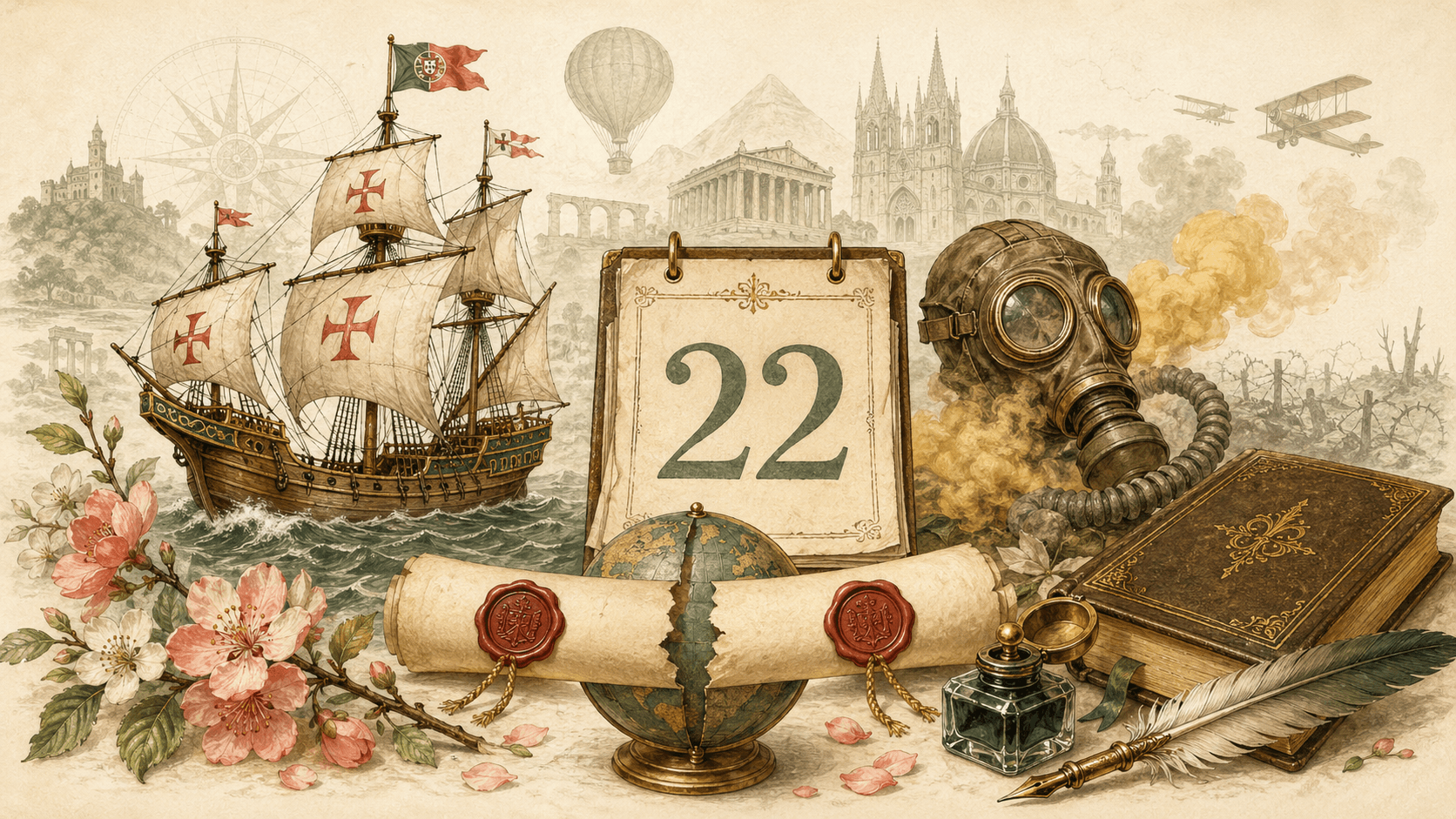
The 10 quiz questions
Question 1 : Which navigator officially discovered Brazil on April 22, 1500?
Possible answers:
- Vasco da Gama
- Amerigo Vespucci
- Pedro Álvares Cabral
- Ferdinand Magellan
Explanation: Pedro Álvares Cabral, commanding a Portuguese fleet of 13 ships en route to the Indies, reached Brazil by chance during a maneuver to avoid the winds of the Gulf of Guinea. He named the territory "Terra de Vera Cruz". Brazil became the only nation in South America to speak Portuguese, a direct legacy of this discovery.
Question 2 : During the Second Battle of Ypres in 1915, what chemical weapon did the Germans use for the first time on the French front?
Possible answers:
- Mustard gas
- Chlorine gas
- Phosgene gas
- Sarin gas
Explanation: On April 22, 1915, the Germans launched approximately 168 tons of chlorine gas from 5,700 buried cylinders, creating a greenish cloud over 6 km of front. This attack caused between 6,000 and 10,000 Allied casualties in a few minutes. It marked a turning point in military history and led to the prohibition of chemical weapons by the Geneva Protocol of 1925.
Question 3 : Which great German philosopher, born on April 22, 1724, is notably the author of the "Critique of Pure Reason"?
Possible answers:
- Friedrich Hegel
- Arthur Schopenhauer
- Friedrich Nietzsche
- Immanuel Kant
Explanation: Immanuel Kant, born in Königsberg (today Kaliningrad in Russia), never left his hometown all his life, which is paradoxical for a thinker of such global influence. His "Critique of Pure Reason" (1781) revolutionized Western philosophy by attempting to reconcile rationalism and empiricism. He is considered one of the greatest philosophers of the Enlightenment.
Question 4 : In what year was the first stone of the Bastille fortress laid?
Possible answers:
- 1310
- 1370
- 1420
- 1450
Explanation: Laid on April 22, 1370 under the reign of Charles V, the Bastille was built by Hugues Aubriot to defend the Saint-Antoine gate of Paris. Initially a military fortress, it gradually became a state prison. It was stormed on July 14, 1789, a founding event of the French Revolution, and razed in the year that followed.
Question 5 : Miles Davis finished recording "Kind of Blue" on April 22, 1959. What distinction did this album obtain?
Possible answers:
- The first jazz album to receive a Grammy Award
- Long the best-selling jazz album of all time
- The first jazz album recorded in stereo
- The album having spent the most weeks at the top of the charts
Explanation: "Kind of Blue" is considered the best-selling jazz record of all time, with more than 5 million copies in the United States alone. Recorded in only two sessions (March and April 1959), it defined modal jazz and influenced generations of musicians. Most of the tracks were played in a single take, which testifies to the genius of the musicians present, including John Coltrane and Bill Evans.
Question 6 : How many countries signed the agreement from COP21 on April 22, 2016 in New York?
Possible answers:
- 132 countries
- 156 countries
- 174 countries
- 195 countries
Explanation: The signing by 174 countries on the very first day constituted a historic record for an international agreement. COP21 had taken place in December 2015 at Paris-Le Bourget. The Paris Agreement aims to limit global warming to 1.5°C compared to pre-industrial levels. Entered into force on November 4, 2016, it remains the global reference framework for the fight against climate change.
Question 7 : Lenin, born on April 22, 1870, is the founder of which state?
Possible answers:
- The People's Republic of China
- The Soviet Union
- The Republic of Yugoslavia
- The People's Republic of Poland
Explanation: Vladimir Ilyich Ulyanov, known as Lenin, founded the Soviet Union after the October Revolution of 1917. His real surname was Ulyanov, and the pseudonym "Lenin" reportedly comes from the Lena River in Siberia. After his death in 1924, his body was embalmed and displayed in a mausoleum on Red Square in Moscow, where it is still visible today.
Question 8 : Which 16th-century diplomatic congress, signed on April 22, settled the dispute between Spain and Portugal regarding the Moluccan Islands?
Possible answers:
- The Treaty of Saragossa
- The Treaty of Cateau-Cambrésis
- The Treaty of Westphalia
- The Treaty of Utrecht
Explanation: The Treaty of Saragossa of 1529 extended the Treaty of Tordesillas of 1494 by defining a line of demarcation in the Pacific Ocean. Spain renounced its claims on the Moluccas (today Indonesia) in exchange for 350,000 gold ducats paid by Portugal. These islands were then coveted for their spices, including cloves and nutmeg.
Question 9 : Which great figure of French Enlightenment literature, known for her literary salon and political writings, was born on April 22, 1766?
Possible answers:
- Mary Wollstonecraft
- Olympe de Gouges
- Germaine de Staël
- George Sand
Explanation: Germaine de Staël, daughter of the banker and minister Necker, was one of the most influential women of letters of her time. Her Parisian salon brought together the greatest minds of the late 18th century. Napoleon, whom she openly criticized, exiled her several times. Her work "On Germany" (1813) helped to make German Romanticism known in France.
Question 10 : In which scientific field did Robert Oppenheimer, born on April 22, 1904, play a major historical role?
Possible answers:
- The discovery of the structure of DNA
- The development of the polio vaccine
- The development of the atomic bomb
- The theory of general relativity
Explanation: Robert Oppenheimer led the Manhattan Project, the secret American program that developed the first atomic bomb during World War II. Nicknamed "the father of the atomic bomb", he subsequently expressed deep regrets about its use. He was sadly marginalized during McCarthyism in the 1950s, accused of communist sympathies, before being rehabilitated in 1963.

