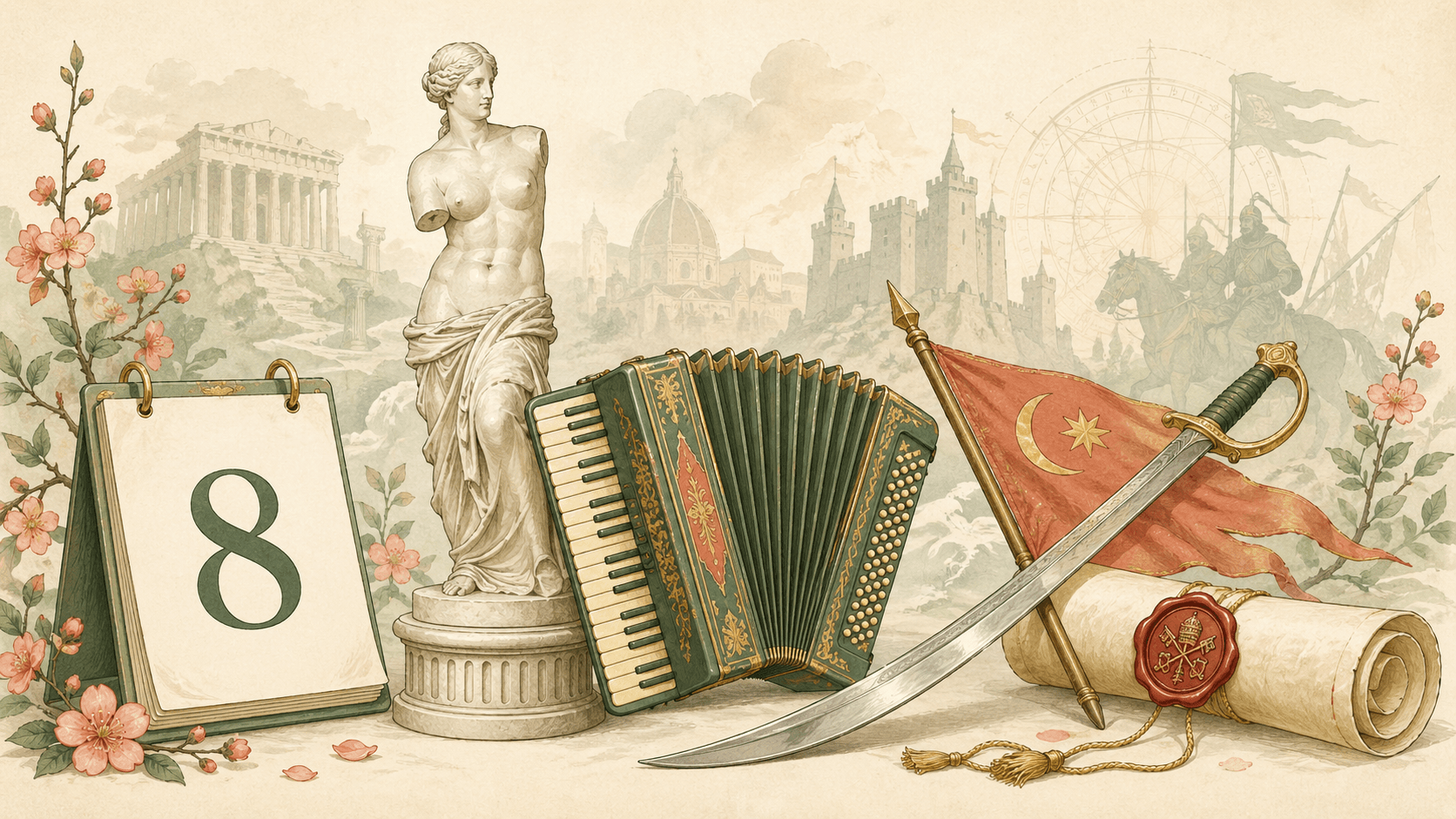
The 10 quiz questions
Question 1 : In what year did France and the United Kingdom sign the Entente Cordiale?
Possible answers:
- 1870
- 1898
- 1904
- 1914
Explanation: The Entente Cordiale, signed on April 8, 1904, ended centuries of Franco-British rivalry and laid the foundation for military cooperation that would prove crucial during the First World War. It notably resolved conflicting interests in Egypt and Morocco.
Question 2 : Which Dutch physicist discovered superconductivity on April 8, 1911?
Possible answers:
- Niels Bohr
- Max Planck
- Kamerlingh Onnes
- Ernest Rutherford
Explanation: Heike Kamerlingh Onnes discovered superconductivity by observing that the electrical resistance of mercury dropped to zero at very low temperatures. He received the Nobel Prize in Physics in 1913 for this revolutionary discovery, which is now the basis for many technologies such as MRI scanners.
Question 3 : Which referendum took place in France on April 8, 1962?
Possible answers:
- The French approved the Évian Accords to end the Algerian War
- The French approved the Constitution of the Fifth Republic
- The French approved entry into the European Economic Community
- The French approved the election of the president by direct universal suffrage
Explanation: The referendum of April 8, 1962 concerned the approval of the Évian Accords, which ended the Algerian War after eight years of conflict. More than 90% of voters approved these accords, signed on March 19, 1962. Algeria's independence was proclaimed on July 5, 1962.
Question 4 : Which Belgian singer, born on April 8, 1929, is famous for his poetic and committed songs such as "Ne me quitte pas"?
Possible answers:
- Georges Brassens
- Charles Aznavour
- Jacques Brel
- Léo Ferré
Explanation: Jacques Brel, born in Schaerbeek, Belgium, is one of the major figures of 20th-century French-language song. Apart from his musical career, he was also an actor and a sailor. He settled in the Marquesas Islands in his later years and died in 1978 of lung cancer.
Question 5 : Which Turco-Mongol warrior, founder of the Timurid dynasty, was born on April 8, 1336?
Possible answers:
- Genghis Khan
- Tamerlane
- Suleiman the Magnificent
- Attila
Explanation: Tamerlane, whose real name was Timur, ruled over a vast empire stretching from Persia to India. His conquests were marked by extreme brutality, notably the sack of Delhi in 1398 and that of Baghdad in 1401. He died in 1405 while preparing to invade China.
Question 6 : On April 8, 1802, Napoleon Bonaparte promulgated a Concordat with Pope Pius VII. What is a Concordat?
Possible answers:
- An agreement between the Holy See and a sovereign state regulating relations between the Catholic Church and the latter
- A military treaty between two Christian nations
- A text defining the dogmas of the Roman Catholic Church
- An official declaration of canonization of a saint by the Pope
Explanation: The Concordat of 1801 (promulgated in 1802) ended the religious schism born from the French Revolution. It recognized Catholicism as the religion of the majority of the French but not as a state religion. This concordat remained in force until the law on the separation of Church and State of 1905, except in Alsace-Moselle where it still applies today.
Question 7 : On April 8, 1820, which famous ancient sculpture was unearthed on the island of Milos in the Aegean Sea?
Possible answers:
- The Winged Victory of Samothrace
- The Apollo Belvedere
- The Discobolus
- The Venus de Milo
Explanation: The Venus de Milo was discovered by a Greek peasant, Yorgos Kentrotas, and sold to the French ambassador. It was offered to King Louis XVIII who gave it to the Louvre in 1821. Dating from around 100 BC, it most likely represents Aphrodite. Its missing arms have always been the subject of much speculation.
Question 8 : In what year did Louis XIII purchase the seigneury of Versailles, future location of the royal palace?
Possible answers:
- 1624
- 1632
- 1643
- 1661
Explanation: Louis XIII bought the seigneury of Versailles on April 8, 1632 from Jean-François de Gondi. He had a first hunting lodge built there in 1624, then a small castle between 1631 and 1634. It was his son Louis XIV who radically transformed this estate by having the immense Palace of Versailles built and making it the seat of the royal government from 1682.
Question 9 : Kofi Annan, born on April 8, 1938, served as Secretary-General of the United Nations. With which international organization was he also associated when he received the Nobel Peace Prize in 2001?
Possible answers:
- The African Union
- The International Committee of the Red Cross
- The World Trade Organization
- The United Nations
Explanation: Kofi Annan and the UN itself jointly received the Nobel Peace Prize in 2001. A Ghanaian diplomat, he was the seventh Secretary-General of the UN from 1997 to 2006. After his term, he continued to work for peace as a mediator in various international crises, notably in Syria in 2012.
Question 10 : On April 8, 2010, Barack Obama and Dmitry Medvedev signed a new START treaty. What does this type of treaty mainly govern?
Possible answers:
- The limitation of underground nuclear tests
- Nuclear disarmament and the reduction of strategic arsenals
- The non-proliferation of chemical and biological weapons
- The total worldwide ban on nuclear weapons
Explanation: The New START treaty (Strategic Arms Reduction Treaty), signed in Prague, limited the number of deployed strategic nuclear warheads to 1,550 per side, a reduction of about 30% compared to the previous treaty. It was ratified by both countries in 2011 and extended in 2021 for five years. This treaty represented one of the pillars of nuclear non-proliferation between the two superpowers.

