The 10 quiz questions
Question 1 : In what year do the mutual excommunications between Rome and Constantinople take place?
Possible answers:
- 800
- 1054
- 1204
- 1453
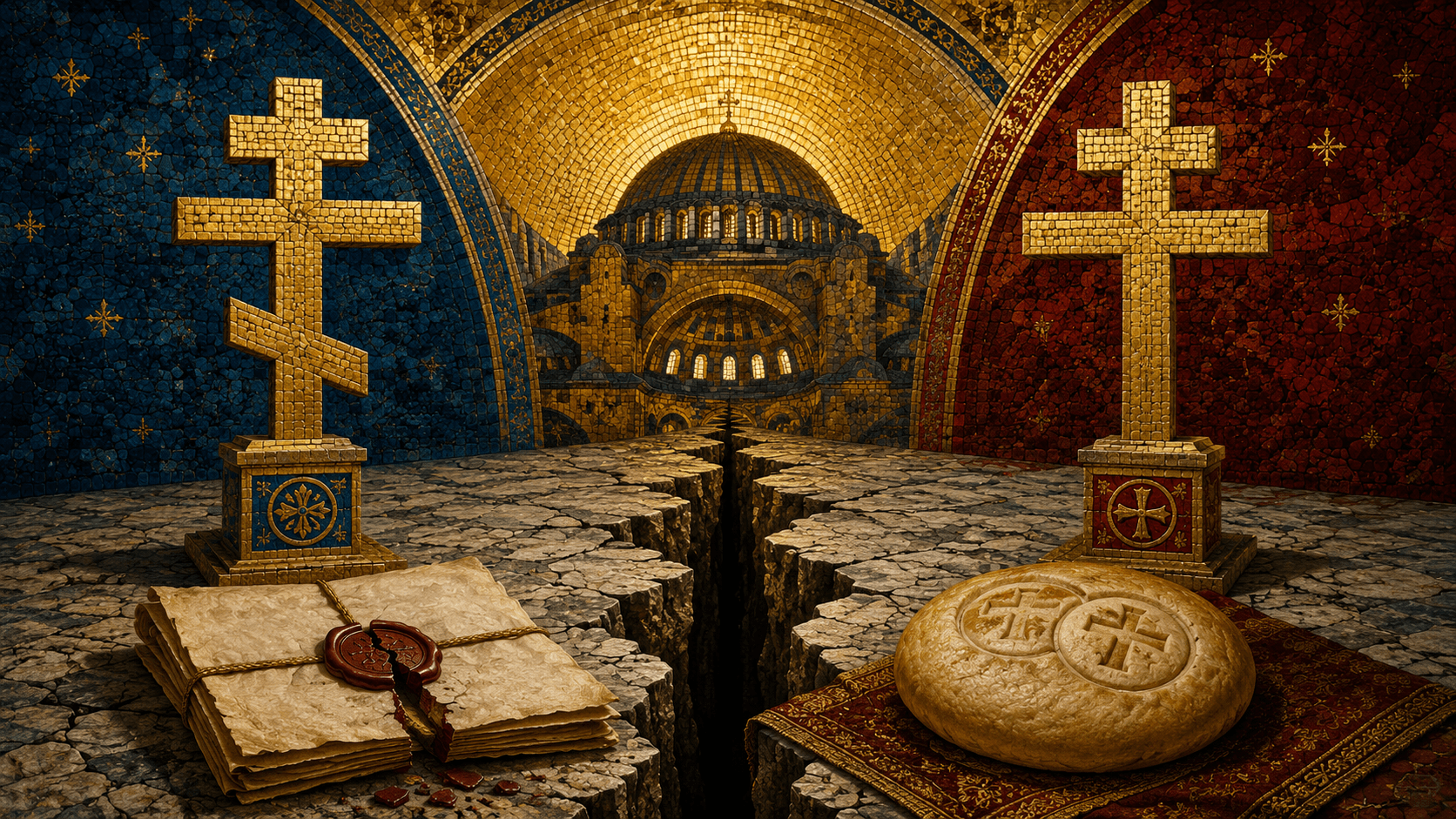
Explanation: On July 16, 1054, Cardinal Humbert laid a bull of excommunication against Patriarch Michael Cerularius on the altar of Hagia Sophia. The latter responded with a symmetrical excommunication of the cardinal. Irony of history: both men excommunicated specific persons, not the two Churches. The break was qualified as a schism only later.
Question 2 : What does the "filioque" controversy between Rome and Constantinople refer to?
Possible answers:
- The Latin addition "and from the Son" in the Creed
- Mary's role in salvation
- The date of Easter
- The use of Greek in Western liturgy
Explanation: The Latin word filioque ("and from the Son") was added by the Latins to the Nicene-Constantinopolitan Creed to specify that the Holy Spirit proceeds from the Father "and from the Son". The Easterners rejected this addition, which they considered unilateral and theologically wrong. The quarrel sounds tiny but it has structured ten centuries of mutual distrust.
Question 3 : Which practice clearly sets the Orthodox clergy apart from the Roman Catholic clergy?
Possible answers:
- Strict celibacy for the entire clergy
- Marriage allowed for priests before ordination
- Total ban on any hereditary priesthood
- Ordination of women to the priesthood
Explanation: Orthodox priests can marry, provided they do so before ordination. Bishops, on the other hand, are chosen from among celibate monks. This is exactly the opposite of the Latin model imposed from the eleventh century onwards. In daily life, it really changes the priest's place in the village: he has a wife and children like everyone else.
Question 4 : Which difference concerns the bread used in the eucharist between the two Churches?
Possible answers:
- The Orthodox use leavened bread, Catholics unleavened bread
- Bread is dipped in wine only by Catholics
- Consecrated bread is gilded among the Orthodox
- The Orthodox use rye bread, Catholics wheat bread
Explanation: The Orthodox use leavened bread, a symbol for them of the risen and living Christ. Catholics use unleavened bread, in direct reference to the Jewish Passover and the Last Supper. The quarrel of "azymites" against "fermentarians" was at the heart of eleventh-century tensions.
Question 5 : In which century does the iconoclastic crisis that shakes the Byzantine Empire break out?
Possible answers:
- 6th century
- 7th century
- 8th century
- 10th century
Explanation: Emperor Leo III banned the cult of images in 726. The crisis lasted more than a century, with a remission in the ninth before finally ending in 843 (the "Triumph of Orthodoxy", a feast still celebrated on the first Sunday of Orthodox Lent). Along the way, thousands of ancient icons were destroyed: a huge part of early Byzantine art was lost.
Question 6 : Which patriarch holds the honorary title of "ecumenical" in the Orthodox world?
Possible answers:
- The Patriarch of Constantinople
- The Patriarch of Moscow
- The Patriarch of Alexandria
- The Patriarch of Jerusalem
Explanation: The Patriarch of Constantinople has held this title since the sixth century. In practice he has no jurisdictional authority over other Orthodox Churches (which are independent or "autocephalous"), but he has primacy of honor. Today the holder is Bartholomew I. He lives in Istanbul but leads only a community of a few thousand faithful.
Question 7 : In what year does Constantinople definitively fall into Ottoman hands?
Possible answers:
- 1054
- 1204
- 1453
- 1517
Explanation: On May 29, 1453, Mehmed II the Conqueror took Constantinople after a two-month siege. Emperor Constantine XI Palaiologos died fighting. Hagia Sophia became a mosque. It was the end of the Eastern Roman Empire, which had lasted since 395, and a terrible blow to the Orthodox world: the seat of the ecumenical patriarch came under Muslim tutelage.
Question 8 : What is the main liturgical form of the Orthodox Church called?
Possible answers:
- The Ambrosian rite
- The Coptic rite
- The Syriac rite
- The Byzantine rite
Explanation: The Byzantine rite is marked by its Divine Liturgy of Saint John Chrysostom or Saint Basil, celebrated behind the iconostasis, without organ (a cappella singing) and with a length of around two hours. The rite is also used by some Catholic Churches called "uniates", which recognize the pope while keeping the Eastern liturgy.
Question 9 : Which symbolic gesture marks the official end of the 1054 excommunications, nine centuries later?
Possible answers:
- The meeting of John XXIII with a patriarch in 1959
- The mutual lifting of excommunications in 1965 by Paul VI and Athenagoras
- The signing of a joint declaration by John Paul II in 1999
- The concelebration of a Mass by Francis and Patriarch Kirill
Explanation: On December 7, 1965, at the close of Vatican II, Pope Paul VI and Patriarch Athenagoras simultaneously lifted the excommunications. The gesture is purely symbolic: the two Churches remain separate and still do not commune together. But it was a major diplomatic breakthrough, after nine centuries of mutual resentment.
Question 10 : What does the term "autocephalous" applied to an Orthodox Church mean?
Possible answers:
- That it has its own distinct liturgical rite
- That it uses Greek in the liturgy
- That it was founded before the 1054 schism
- That it is independent and elects its own leader
Explanation: The word comes from the Greek autos ("oneself") and kephale ("head"). An autocephalous Church elects its own leader and runs its own affairs without higher authority: it is the opposite of the Catholic pyramidal organization. There are 15 autocephalous Orthodox Churches today (Constantinople, Moscow, Romania, Greece, etc.), sometimes in conflict with each other, as in the recent Ukrainian crisis.