The 10 quiz questions
Question 1 : Which wonder allows the Hebrews to flee Pharaoh's army according to Exodus?
Possible answers:
- The parting of the sea
- A sandstorm
- A sudden eclipse
- The appearance of a dragon
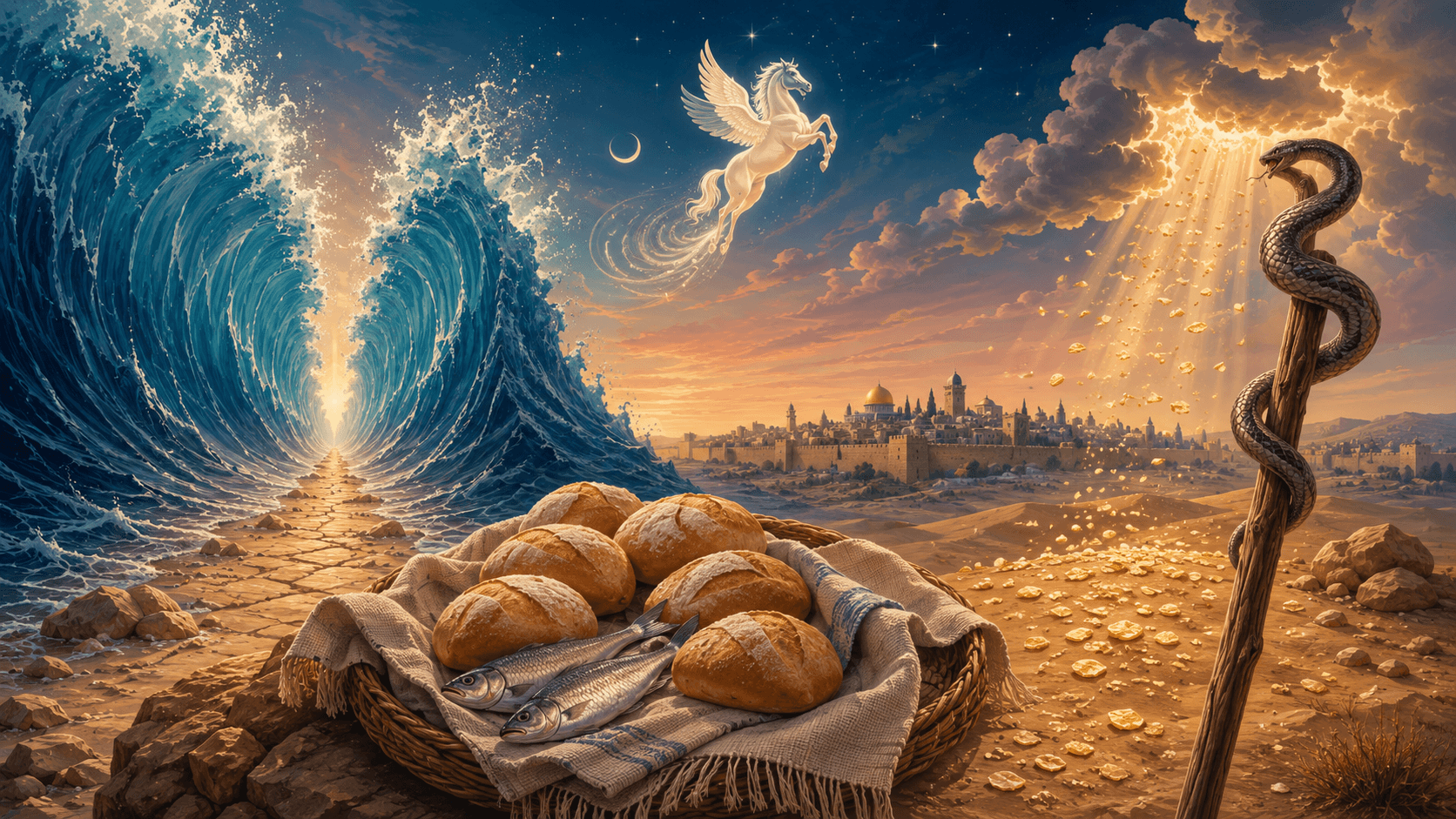
Explanation: The opening of the Red Sea is told in chapter 14 of Exodus. Moses extends his staff, an east wind blows all night and the water parts. Scholars debate the exact location: "yam suph" in Hebrew can mean "sea of reeds", possibly a marshy lake north of the Gulf of Suez, rather than the Red Sea proper.
Question 2 : How many loaves does Jesus multiply to feed five thousand people according to the Gospels?
Possible answers:
- 3
- 5
- 7
- 12
Explanation: The miracle of the "five loaves and two fish" is the only one to appear in all four Gospels, making it one of the best-attested accounts. John adds a detail: the leftovers fill twelve baskets, the number of the twelve tribes of Israel. A multiplication that also works in symbolic numbers.
Question 3 : Which friend of Jesus is resurrected after four days in the tomb, according to the Gospel of John?
Possible answers:
- Joseph of Arimathea
- Nicodemus
- Lazarus
- Zacchaeus
Explanation: Lazarus of Bethany is brought back to life by a Jesus who first weeps before his tomb ("Jesus wept", verse 35 of John 11, the shortest in the Bible in many translations). The miracle decides the Jewish authorities to eliminate Jesus, according to John. Lazarus is said to have then ended his days either in Cyprus or in Provence, where he is venerated as the first bishop of Marseille; his relics are traditionally linked to Autun.
Question 4 : On what body of water does Jesus walk according to the Gospels of Matthew, Mark and John?
Possible answers:
- The Dead Sea
- The Jordan River
- The Mediterranean
- The Lake of Galilee
Explanation: The Lake of Galilee (also called Sea of Galilee, Lake of Tiberias or Gennesaret) is in fact a freshwater lake 21 km long. The account in Matthew 14 shows Peter trying to imitate Jesus and beginning to sink for lack of faith. A scene often reused in painting, from Konrad Witz to Eugène Delacroix.
Question 5 : What heavenly food falls from the sky to feed the Hebrews during the crossing of the desert?
Possible answers:
- Manna
- Ambrosia
- Nectar
- Unleavened bread
Explanation: Manna falls every morning except on the Sabbath day (double ration the day before). Its name is said to come from the Hebrews' question: "Man hu?", that is, "What is it?". Scientific identification remains debated: a secretion of parasitic insects on Sinai tamarisks for some, edible lichen for others.
Question 6 : From which city does Muhammad depart for his famous night journey, the Isra and Miraj?
Possible answers:
- Medina
- Mecca
- Damascus
- Baghdad
Explanation: The journey begins in Mecca, where Muhammad is sleeping near the Kaaba. The angel Jibril wakes him, brings him a mount called Buraq and takes him first to Jerusalem (the Isra), then through the seven heavens (the Miraj) where he meets the previous prophets. It is during this journey that the five daily prayers are said to have been instituted.
Question 7 : Into what does Moses' staff transform to convince Pharaoh?
Possible answers:
- An eagle
- A lion
- A serpent
- A tree
Explanation: The staff becomes a serpent before Pharaoh. The Egyptian magicians reproduce the trick, but Moses' serpent swallows them all. The Hebrew word used is "tannin", which means rather "sea monster" or "dragon" than "serpent" in the strict sense. A nuance often lost in modern translations.
Question 8 : How many plagues strike Egypt before Pharaoh lets the Hebrews leave?
Possible answers:
- 3
- 7
- 9
- 10
Explanation: The ten plagues go from blood in the Nile water to the death of the firstborn. Researchers have proposed cascading natural explanations (toxic red algae causing the frogs to flee, etc.), an appealing but criticized theory. In the biblical narrative, Pharaoh gives in to free the Hebrews but then changes his mind, justifying the pursuit toward the sea.
Question 9 : Which wonder attributed to Muhammad in Islamic tradition is said to have occurred in the sky of Mecca?
Possible answers:
- The moon split in two
- An inverted rainbow
- A shower of stars
- Three simultaneous suns
Explanation: Sura 54 of the Quran opens with "The Hour has come near, and the Moon has split". Tradition (hadith) interprets this verse as a miracle in which Muhammad would have literally split the moon in two to respond to the Meccans' demand for signs. Modern scholars rather see it as an eschatological metaphor.
Question 10 : On the summit of which mountain does Moses meet God for the first time, in a burning bush that is not consumed?
Possible answers:
- Mount Carmel
- Mount Horeb
- Mount Ararat
- Mount Nebo
Explanation: Horeb is often identified with Mount Sinai, but the debate remains open. God reveals there his mysterious name, "I am who I am" (YHWH in Hebrew, unpronounceable in Judaism out of respect). Saint Catherine's monastery, founded in the 6th century, claims to keep a descendant of the bush, planted next to the commemorative chapel.