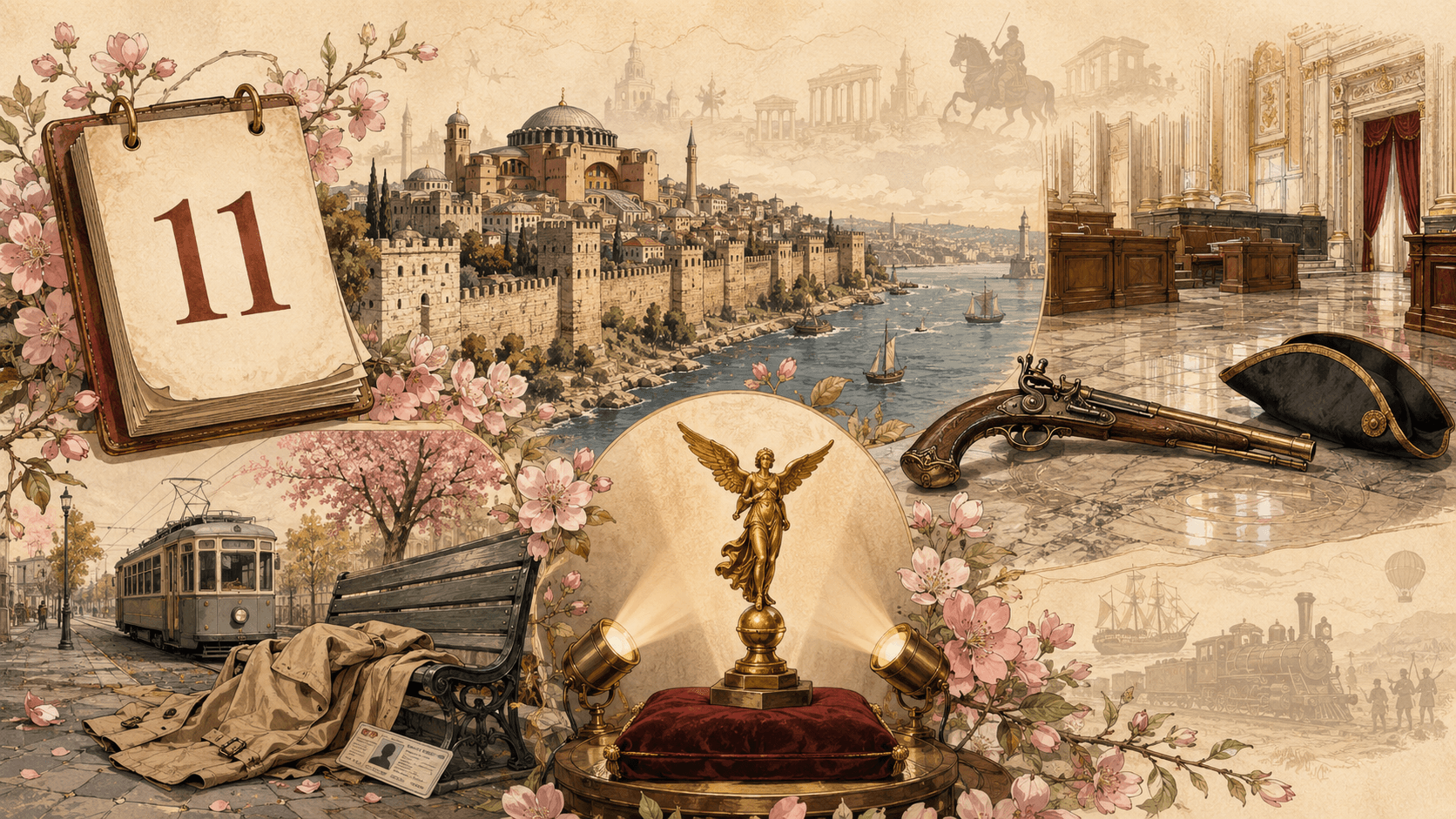
The 10 quiz questions
Question 1 : In 330, which city was officially renamed Constantinople by Emperor Constantine I to become the new capital of the Roman Empire?
Possible answers:
- Antioch
- Byzantium
- Alexandria
- Nicaea
Explanation: Constantinople, formerly Byzantium, remained the capital of the Eastern Roman Empire and then of the Byzantine Empire for more than a thousand years, until its capture by the Ottomans in 1453. It is now called Istanbul.
Question 2 : Which British Prime Minister was assassinated in 1812 in the lobby of the House of Commons in London?
Possible answers:
- William Pitt the Younger
- Spencer Perceval
- Robert Walpole
- Henry Addington
Explanation: Spencer Perceval is to this day the only British Prime Minister to have been assassinated. His murderer, John Bellingham, was a merchant who blamed him for failing to obtain compensation from the government after an unjust imprisonment in Russia.
Question 3 : In 1867, which treaty guaranteed the independence and perpetual neutrality of a small Western European country that is still neutral today?
Possible answers:
- Treaty of Westphalia
- Treaty of London
- Treaty of Paris
- Treaty of Vienna
Explanation: The Treaty of London of 1867 made Luxembourg a neutral and disarmed state. This neutrality was nevertheless violated by Germany during the two world wars. Luxembourg is today a founding member of the European Union and NATO.
Question 4 : In 1960, the Mossad captured Adolf Eichmann in Buenos Aires. What was Eichmann's main role in the Nazi regime?
Possible answers:
- Commandant of the concentration camps in Poland
- Logistical coordinator of the deportation of Jews to the camps
- Head of the Gestapo in occupied France
- Head of propaganda for the Third Reich
Explanation: Eichmann was one of the principal logistical organisers of the Shoah, coordinating the deportations of millions of Jews to the extermination camps. His trial in Jerusalem in 1961 had a worldwide impact and helped make the reality of the Final Solution known to the general public.
Question 5 : Which American institution dedicated to cinema was founded on 11 May 1927 in Los Angeles?
Possible answers:
- The American Film Institute
- The Screen Actors Guild
- The Academy of Motion Picture Arts and Sciences
- The Motion Picture Association of America
Explanation: The Academy of Motion Picture Arts and Sciences, founded in 1927, organised its first Oscars ceremony in 1929. The golden statuette owes its nickname "Oscar" to an anecdote attributed to several personalities, including the Academy's librarian Margaret Herrick.
Question 6 : In 1986, Jean-Louis Étienne became the first man to reach the North Pole solo. Which detail applies to this feat?
Possible answers:
- Without any assistance or resupply
- With external logistical assistance
- On skis with a sled dog
- Using an adapted motorised vehicle
Explanation: Jean-Louis Étienne accomplished this feat in 63 days, pulling his sled himself. The detail "with assistance" means that he benefited from regular air resupplies, which distinguishes him from attempts without any outside support. He is also known for his Antarctic expeditions and his environmental commitments.
Question 7 : The painting "Les Femmes d'Alger, version O" by Pablo Picasso was sold at auction for a record price in 2015. What was the sale price?
Possible answers:
- About 120 million dollars
- About 250 million dollars
- About 179 million dollars
- About 95 million dollars
Explanation: This 1955 painting belongs to a series of fifteen variations that Picasso made as a tribute to Eugène Delacroix. Since this record sale of 179.3 million dollars, the title of most expensive painting has been disputed by other works, notably those of Leonardo da Vinci and Andy Warhol.
Question 8 : At the Battle of Fontenoy in 1745, which broader European conflict did this confrontation fit into?
Possible answers:
- The Seven Years' War
- The War of the Austrian Succession
- The War of the Spanish Succession
- The Thirty Years' War
Explanation: The Battle of Fontenoy saw the French troops of Marshal de Saxe defeat the Austro-British forces. This victory is often associated with the famous apostrophe "Fire first, you English, gentlemen", whose historical authenticity is, however, debated.
Question 9 : Born on 11 May 1904, which famous Spanish painter is known for his surrealist style and his dreamlike and provocative images?
Possible answers:
- Joan Miró
- Salvador Dalí
- Pablo Picasso
- Francisco Goya
Explanation: Salvador Dalí is one of the major figures of surrealism, an artistic movement founded by André Breton. His best-known work, "The Persistence of Memory" (1931), depicts soft watches in a desert landscape. He was also a friend and collaborator of the filmmaker Luis Buñuel.
Question 10 : In 1950, which play by Eugène Ionesco was performed for the first time, becoming a symbol of the theatre of the absurd?
Possible answers:
- Waiting for Godot
- The Bald Soprano
- The Chairs
- Rhinoceros
Explanation: The Bald Soprano was first performed on 11 May 1950 at the Théâtre des Noctambules in Paris in near-general indifference. It is today the most performed play in France, played without interruption since 1957 at the Théâtre de la Huchette in Paris. Its title is paradoxical: there is no soprano in the play.

