The 10 quiz questions
Question 1 : How many Gospels make up the canon of the New Testament?
Possible answers:
- 2
- 4
- 7
- 12
Explanation: The canon keeps 4 Gospels: Matthew, Mark, Luke and John. The choice was probably fixed by Irenaeus of Lyon around 180 CE. Other so-called apocryphal gospels (Thomas, Mary, Judas, Peter) were excluded from the canon, some for theological reasons, others simply because they circulated little.
Question 2 : Which apostle is traditionally considered the first pope?
Possible answers:
- Peter
- John
- Andrew
- Thomas
Explanation: Peter, a former fisherman from Galilee named Simon, receives from Jesus the name Cephas ("rock" in Aramaic). Catholic tradition makes him the first bishop of Rome. His presumed tomb, under St. Peter's Basilica, was archaeologically supported by excavations published in 1968.
Question 3 : Which event celebrates the descent of the Holy Spirit upon the apostles?
Possible answers:
- Epiphany
- The Ascension
- The Transfiguration
- Pentecost
Explanation: Pentecost falls 50 days after Easter (from Greek pentēkostē, "fiftieth"). The apostles, until then in hiding, begin to speak all the languages of the known world. For Christians, it is the symbolic birth certificate of the universal Church.
Question 4 : Who wrote most of the epistles of the New Testament?
Possible answers:
- Paul
- James
- Luke
- Barnabas
Explanation: Saul of Tarsus, who became Paul after his conversion on the road to Damascus, signs 13 or 14 epistles depending on the count. Historians actually attribute only 7 to him for certain (Romans, two Corinthians, Galatians, Philippians, first Thessalonians, Philemon), the others being disputed.
Question 5 : In which Gospel do we find the prologue "In the beginning was the Word"?
Possible answers:
- John
- Matthew
- Mark
- Luke
Explanation: John's prologue is one of the theologically densest texts of the New Testament. It identifies Jesus with the divine Logos (Word) and draws its language from Greek Stoic philosophy as much as from the Jewish tradition of the Memra.
Question 6 : How many beatitudes are pronounced in the Sermon on the Mount according to Matthew?
Possible answers:
- 5
- 7
- 8
- 12
Explanation: Matthew lists 8 ("Blessed are the poor in spirit"...). Luke offers a shorter version with 4 beatitudes and 4 mirroring "woes". Both evangelists probably draw from a lost common source that scholars call Q (from German Quelle, "source").
Question 7 : Which disciple handed Jesus over for 30 pieces of silver?
Possible answers:
- Thomas
- Judas Iscariot
- Barabbas
- Simon the Zealot
Explanation: Judas Iscariot hands Jesus over with a kiss in the garden of Gethsemane. The account of his death varies: Matthew says he hangs himself, the Acts of the Apostles say he dies falling into a field. The 30 pieces motif echoes a prophecy from Zechariah.
Question 8 : How many men does Jesus feed according to the miracle of the loaves and fishes?
Possible answers:
- 500
- 1000
- 3000
- 5000
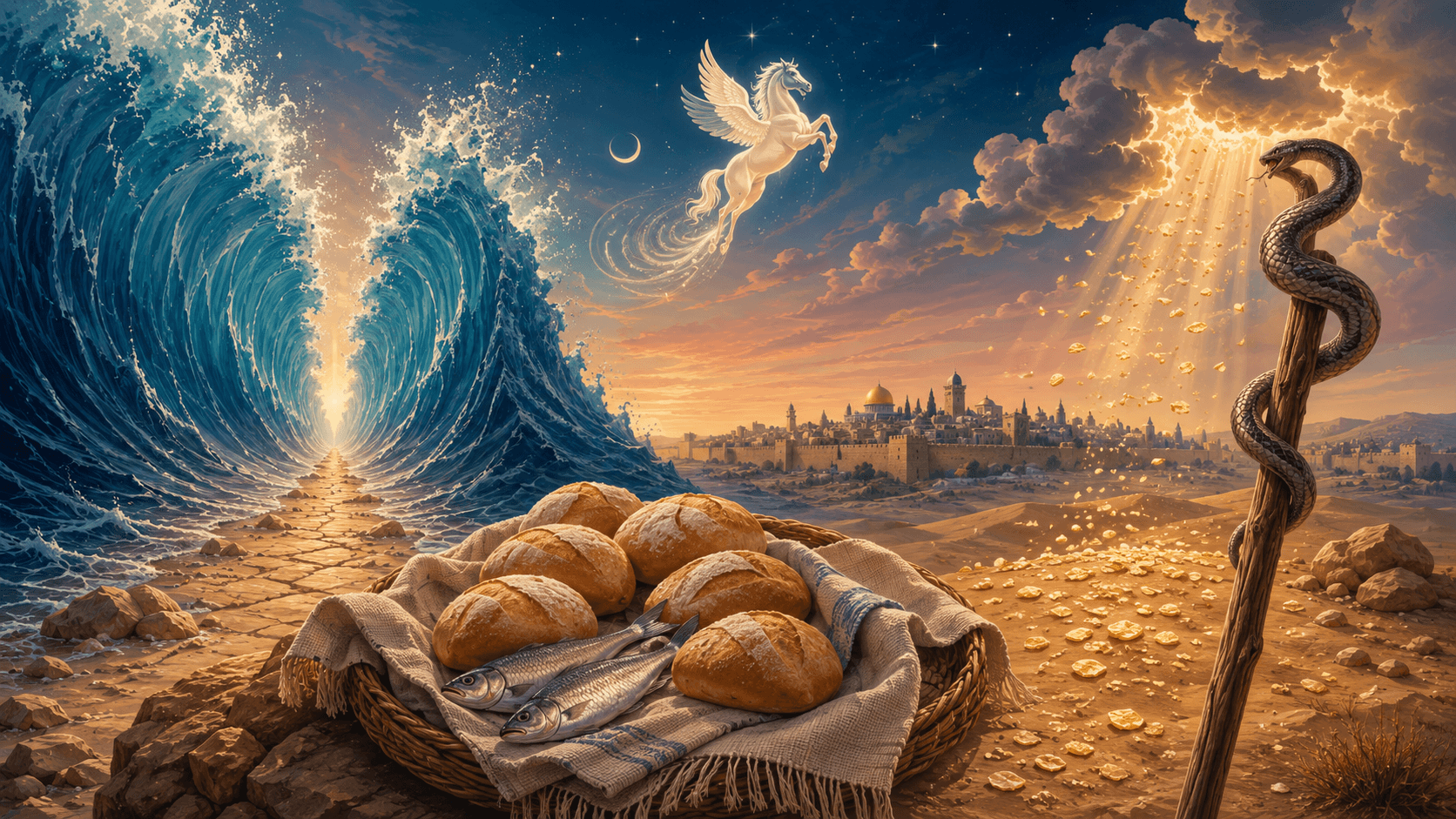
Explanation: The miracle of the 5000 (five loaves and two fish) is one of the few told by all 4 Gospels. Mark then follows with a similar second miracle for 4000 people. Scholars see it as a narrative doubling around a single oral tradition rather than two distinct events.
Question 9 : Which evangelist is traditionally symbolized by a lion?
Possible answers:
- Matthew
- Luke
- Mark
- John
Explanation: The 4 evangelists are symbolized by the 4 "living creatures" of Revelation: Matthew by the winged man, Mark by the lion (referring to the roaring lion of the desert that opens his gospel), Luke by the bull, John by the eagle. An iconography established from the 4th century.
Question 10 : Which book concludes the New Testament?
Possible answers:
- The Acts of the Apostles
- Revelation
- The Epistle to the Hebrews
- The Second Epistle of Peter
Explanation: The Revelation of John (from Greek apokalupsis, "unveiling", not "catastrophe") is traditionally attributed to John the Evangelist. Modern scholars lean rather toward a distinct author, probably a Christian prophet from Asia Minor exiled on the island of Patmos toward the end of the 1st century.