The 10 quiz questions
Question 1 : Which meat is strictly forbidden by the dietary rules of Islam?
Possible answers:
- Beef
- Pork
- Lamb
- Chicken
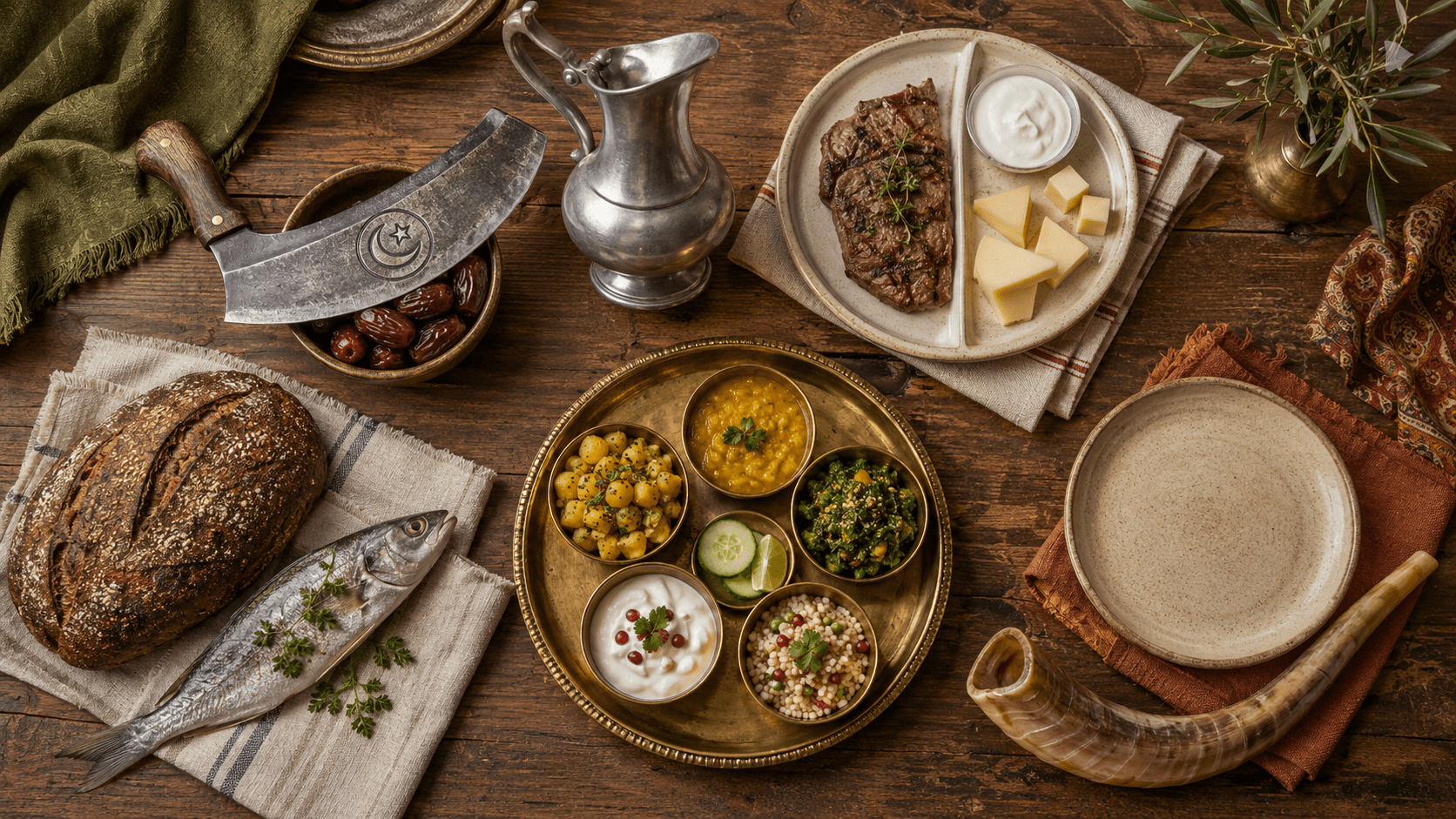
Explanation: Pork is qualified as haram (forbidden) in several verses of the Quran. The ban is shared with Judaism. For other meats, the animal must be ritually slaughtered (dhabiha) by pronouncing the name of God, without stunning, and the animal must be drained of blood.
Question 2 : Which food separation is required by Jewish kashrut?
Possible answers:
- Sweet and salty
- Cooked and raw
- Milk and meat
- Vegetables and fruits
Explanation: Kashrut requires not mixing milk and meat in the same meal, on the same dishes, or even cooking them with the same utensils. The rule is based on the verse "you shall not boil a kid in its mother's milk", repeated three times in the Torah.
Question 3 : How many days does the Christian Lent traditionally last?
Possible answers:
- 30 days
- 40 days
- 49 days
- 53 days
Explanation: Lent lasts 40 days, from Ash Wednesday to Holy Saturday (Sundays are not counted). This duration echoes the 40 days of fasting of Jesus in the desert, themselves an echo of the 40 days of Moses on Sinai. The biblical 40 again.
Question 4 : At what time of day do Muslims fast during Ramadan?
Possible answers:
- From dawn to sunset
- All day and all night
- From noon to sunset
- From sunset to sunrise
Explanation: The fast of Ramadan (sawm) runs from fajr (first light of dawn) to maghrib (sunset). In northern countries, the duration of the day varies enormously: in Iceland in summer, the faithful can go more than 20 hours without eating or drinking. Some religious authorities authorize following the Mecca schedule.
Question 5 : Which animal is considered sacred in Hinduism and whose meat is largely avoided in India?
Possible answers:
- The sheep
- The cow
- The elephant
- The buffalo
Explanation: The cow (gau mata, "mother cow") is considered sacred in Hinduism. Its consumption is forbidden in most Indian states, and its slaughter is even criminally punished in several of them. Ghee (clarified butter), on the other hand, is central to cooking and rituals.
Question 6 : Which dietary practice is encouraged in several Buddhist currents, in connection with the first precept?
Possible answers:
- Intermittent fasting
- Raw foodism
- Vegetarianism
- Weekly fasting
Explanation: Vegetarianism follows from the first Buddhist precept: do not kill living beings. But it is not universal. In Tibet, where few vegetables grow, meat is widely consumed. In Zen Japan, there is shojin ryori, an extremely codified monastic plant-based cuisine.
Question 7 : Which day of the week is traditionally devoted to abstinence from meat among Catholics?
Possible answers:
- Friday
- Monday
- Wednesday
- Saturday
Explanation: Friday abstinence recalls the day of Christ's death. For centuries, this is what boosted fish consumption in Europe: dried cod even shaped entire trade routes. Today the rule mainly applies during Lent.
Question 8 : About how many hours does the Yom Kippur fast last, the great Jewish day of atonement?
Possible answers:
- 12 hours
- 16 hours
- 20 hours
- 25 hours
Explanation: The Yom Kippur fast lasts about 25 hours, from sunset to nightfall the following day. No food, no drink, and according to tradition no leather on the feet or cosmetics either. It is the most important fast in the Jewish calendar, observed even by many otherwise infrequent practitioners.
Question 9 : Which foods do the strictest Jains avoid, in the name of non-violence (ahimsa)?
Possible answers:
- Cereals
- Dried fruits
- Legumes
- Root vegetables
Explanation: Jains avoid root vegetables (onions, garlic, potatoes, ginger) because uprooting them kills the whole plant and also destroys micro-organisms in the soil. Some monks even sweep the ground in front of them to avoid crushing insects. The principle of ahimsa taken to the extreme.
Question 10 : Which drink does Islam forbid to believers?
Possible answers:
- Alcohol
- Coffee
- Tea
- Milk
Explanation: Alcohol (khamr) is forbidden in the Quran. The ban was imposed progressively: three separate verses settle the question in increasingly firm terms. Linguistic anecdote: the English word "alcohol" itself comes from the Arabic al-kuhl, originally a fine powder of eye makeup.