The 10 quiz questions
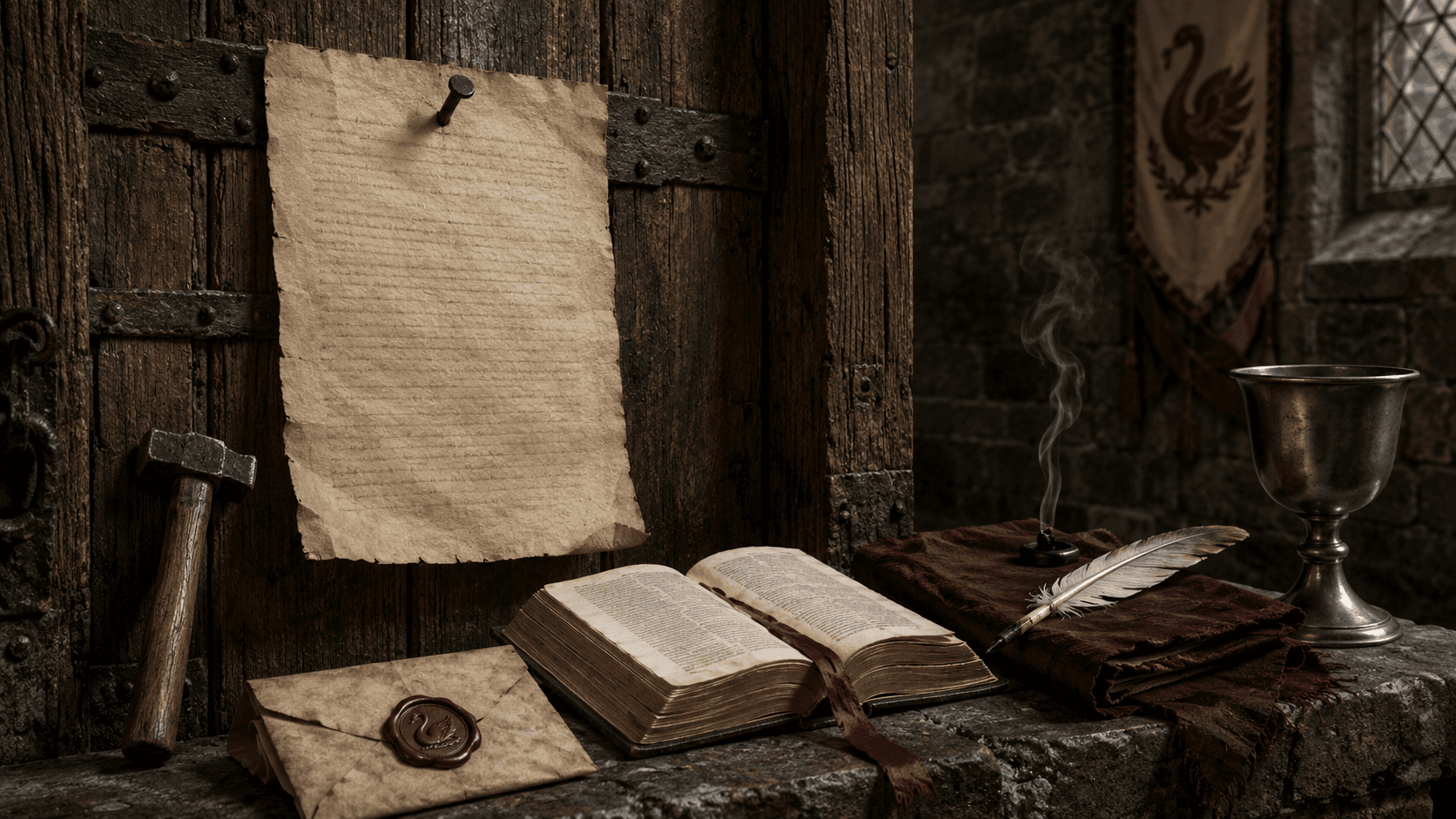
Question 1 : In what year does Luther post his 95 theses on the door of the Wittenberg church?
Possible answers:
- 1492
- 1517
- 1520
- 1545
Explanation: It was October 31, 1517. Fun detail: we are not even sure Luther really nailed them on the door. The mythical episode comes from a late testimony by Melanchthon. What is certain is that he sent them by letter to the Archbishop of Mainz on the same day.
Question 2 : Which Church practice is the main target of the 95 theses?
Possible answers:
- The sale of indulgences
- Priestly celibacy
- The cult of saints
- Purgatory
Explanation: Luther attacks the sale of indulgences, certificates supposed to reduce time in purgatory. Top seller Johann Tetzel toured Germany with the slogan "As soon as a coin in the coffer rings, a soul from purgatory springs". The money collected funded the construction of St. Peter's Basilica in Rome.
Question 3 : In what year does Luther appear before the Diet of Worms facing Charles V?
Possible answers:
- 1483
- 1517
- 1521
- 1555
Explanation: Summoned in 1521, Luther refused to recant with his now-famous line: "Here I stand, I can do no other". Charles V declared him an outlaw through the Edict of Worms. Frederick the Wise, his protector, had him kidnapped to hide him at Wartburg Castle, where he started translating the Bible into German.
Question 4 : Which reformer turns Geneva into the "Protestant Rome" in the sixteenth century?
Possible answers:
- Ulrich Zwingli
- John Calvin
- Theodore Beza
- Philip Melanchthon
Explanation: John Calvin turned Geneva into an austere theocracy from 1541 onwards. He set up the Consistory, which kept watch over the morals of the inhabitants: dancing, theatre, games and banquets were forbidden. His doctrine of predestination (God has chosen the elect in advance) made Geneva the breeding ground of all European reformers.
Question 5 : For what reason does Henry VIII break with Rome to found the Church of England?
Possible answers:
- A doctrinal dispute over transubstantiation
- The refusal to pay a new tax to Rome
- The pope's refusal to annul his marriage
- A dynastic quarrel with Emperor Charles V
Explanation: Henry VIII wanted to divorce Catherine of Aragon, who had not given him a male heir, in order to marry Anne Boleyn. Pope Clement VII refused the annulment. In 1534, the Act of Supremacy made the king head of the Church of England. In the end, Henry VIII had six wives and had Anne Boleyn executed three years later.
Question 6 : In what year does the Saint Bartholomew's Day massacre take place?
Possible answers:
- 1517
- 1521
- 1545
- 1572
Explanation: On the night of August 23 to 24, 1572, thousands of Protestants were massacred in Paris and then in the provinces. Admiral de Coligny was thrown out of the window. The death toll is still debated: between 5,000 and 30,000 deaths according to estimates. King Charles IX and his mother Catherine de Medici claimed responsibility for the operation before Parliament.
Question 7 : Which king of France signs in 1598 the text granting freedom of worship to Protestants?
Possible answers:
- Henry IV
- Francis II
- Charles IX
- Henry III
Explanation: Henry IV signed the Edict of Nantes on April 30, 1598, ending 36 years of wars of religion. A former Protestant himself ("Paris is well worth a Mass"), he guaranteed freedom of worship to Huguenots. The edict was revoked by Louis XIV in 1685, sending several hundred thousand French Protestants into exile.
Question 8 : Which council launches the Catholic Counter-Reformation from 1545 onwards?
Possible answers:
- The Council of Constance
- The Fifth Lateran Council
- The Council of Basel
- The Council of Trent
Explanation: The Council of Trent was held in three sessions spread over 18 years (1545 to 1563). It reaffirmed the dogmas challenged by Protestants (seven sacraments, real presence in the eucharist, authority of the pope) while recognizing the need for moral reforms. It is the matrix of modern Catholicism right up to Vatican II in the twentieth century.
Question 9 : Which religious order does Ignatius of Loyola found in 1540 as the spearhead of the Counter-Reformation?
Possible answers:
- The Jesuits
- The Dominicans
- The Capuchins
- The Discalced Carmelites
Explanation: A former soldier converted after a war injury, Ignatius of Loyola created the Society of Jesus with near-military discipline. The Jesuits would become teachers of the Catholic elite, missionaries in Asia (Francis Xavier in Japan), confessors of kings. The order was suppressed by the pope in 1773 before being reborn in 1814.
Question 10 : Which event triggers the Thirty Years' War in 1618?
Possible answers:
- The assassination of a Protestant prince elector
- The Defenestration of Prague
- The Swedish invasion of Bohemia
- The excommunication of the emperor by the pope
Explanation: In Prague, Protestant nobles threw two imperial representatives out of the window of the royal castle. The Defenestration of Prague lit the fuse. The two men survived thanks to a pile of manure (according to Catholics) or to the intervention of the Virgin Mary (according to the Jesuits). The war lasted 30 years and devastated Germany.