The 10 quiz questions
Question 1 : Which Cambodian temple was originally dedicated to Vishnu before becoming Buddhist?
Possible answers:
- Angkor Wat
- Bayon
- Ta Prohm
- Preah Vihear
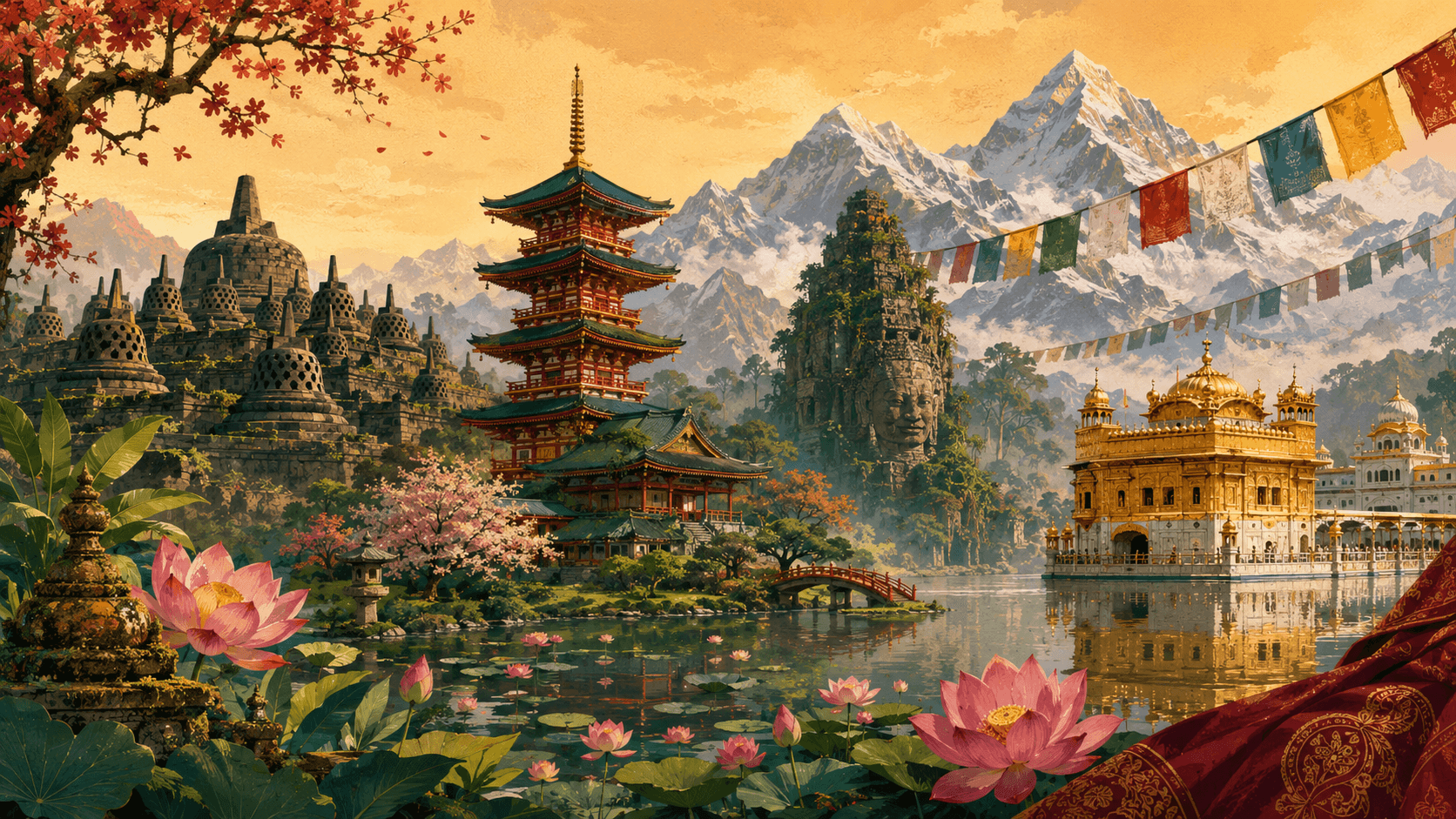
Explanation: Angkor Wat is the largest religious complex in the world, almost twice the area of Vatican City. The temple was begun in the 12th century under Suryavarman II. It appears on the national flag, the only known case of a religious monument on a state's flag.
Question 2 : Which Buddhist monument in Java is the world's largest stupa, with 504 statues of Buddha?
Possible answers:
- Prambanan
- Borobudur
- Sukuh
- Mendut
Explanation: Borobudur was built in the 9th century then mysteriously abandoned a few centuries later, probably after a volcanic eruption. It was rediscovered in the jungle in 1814 by the British. The plan is a giant mandala: you climb from the world of desires to nirvana by ascending the nine terraces.
Question 3 : Which Kyoto temple is entirely covered in gold, except for the ground floor?
Possible answers:
- Ginkaku-ji
- Kiyomizu-dera
- Kinkaku-ji
- Ryoan-ji
Explanation: The Golden Pavilion was built in 1397 by shogun Ashikaga Yoshimitsu, who turned it into his retirement villa. It was burned down in 1950 by a novice monk obsessed with the building's beauty, a sensational case that inspired Yukio Mishima's famous novel. The current structure is a reconstruction.
Question 4 : Which Indian temple marks the spot where the Buddha is said to have reached enlightenment under a tree?
Possible answers:
- Sanchi Stupa
- Ellora Caves
- Ajanta Caves
- The Mahabodhi Temple
Explanation: The Mahabodhi Temple at Bodh Gaya surrounds the Bodhi tree under which Siddhartha Gautama is said to have become the Buddha around 528 BCE. The current tree is a direct descendant of the original fig, propagated by cuttings through the centuries. It is the most important pilgrimage site in Buddhism.
Question 5 : Which Bangkok temple houses Thailand's most sacred statue, carved from jade?
Possible answers:
- Wat Phra Kaew
- Wat Arun
- Wat Pho
- Wat Saket
Explanation: Wat Phra Kaew, known as the Temple of the Emerald Buddha, is located within the royal palace compound. The Emerald Buddha is actually not made of emerald but jade. The king himself changes its robes three times a year, at each change of season, during a private ceremony.
Question 6 : Which Tibetan palace-monastery was the official residence of the Dalai Lama until 1959?
Possible answers:
- Tashilhunpo Monastery
- The Potala Palace
- Drepung Monastery
- Sera Monastery
Explanation: The Potala has more than 1,000 rooms spread over 13 floors, perched at 3,700 meters altitude. The 14th Dalai Lama left it in 1959 to go into exile in India after the Chinese invasion of Tibet. The building is now a museum, which deeply saddens the Tibetan community.
Question 7 : Which Chinese monastery is famous worldwide as the cradle of kung-fu and Chan Buddhism?
Possible answers:
- Wudang Monastery
- White Horse Temple
- Shaolin Monastery
- Temple of Heaven
Explanation: The Shaolin Monastery was founded in 495 in Henan province. According to legend, the Indian monk Bodhidharma introduced Chan (zen in Japanese) there and invented the first physical exercises to help monks endure meditation. Today it has become a global brand as much as a spiritual site.
Question 8 : Which Burmese plain shelters about 2,000 stupas and pagodas built between the 11th and 13th centuries?
Possible answers:
- Mandalay
- Inle
- Mrauk U
- Bagan
Explanation: Bagan had up to 10,000 monuments at its peak, but many were destroyed by earthquakes and looting. The site was only UNESCO-listed in 2019, which is late, partly because of restorations considered sloppy by international experts.
Question 9 : Over approximately how many hectares does the Angkor Wat site extend?
Possible answers:
- 162 hectares
- 300 hectares
- 500 hectares
- 1,000 hectares
Explanation: 162 hectares for the main temple alone, more than 400 km² if you include the whole Angkor archaeological complex. The medieval city of Angkor was probably the largest preindustrial urban area in history, with perhaps a million inhabitants in the 12th century.
Question 10 : What are the multi-tiered Buddhist buildings characteristic of East Asia called?
Possible answers:
- Ziggurats
- Pagodas
- Mandirs
- Gopurams
Explanation: The pagoda derives from the Indian stupa but evolved into a vertical form as it spread to China, then Korea and Japan. The tiered roofs are not just aesthetic: they dampen earthquakes, which explains why some Japanese pagodas standing for more than 1,300 years have survived seismic shocks.